
In large-scale industrial fluid processing, flow rate is synonymous with profitability. Whether you are managing a seawater desalination facility, a massive municipal water treatment plant, an oilfield reinjection system, or a high-volume chemical processing line, a single hour of unplanned downtime or an inefficient filtration bottleneck can cost tens of thousands of dollars.
To keep pace with demanding flow requirements while maintaining a compact plant footprint, industries have universally shifted toward high-flow filtration technology. However, a premium pleated filter cartridge is only as good as the vessel that holds it. If your filter vessel suffers from bypass leaks, structural fatigue, or poor hydraulic design, your entire process is at risk.
Choosing the right high flow cartridge filter housing manufacturer is one of the most critical decisions an engineering procurement manager can make. This comprehensive guide breaks down the technical specifications, structural engineering principles, and manufacturing standards required to source world-class filter housings that secure your process integrity for years to come.
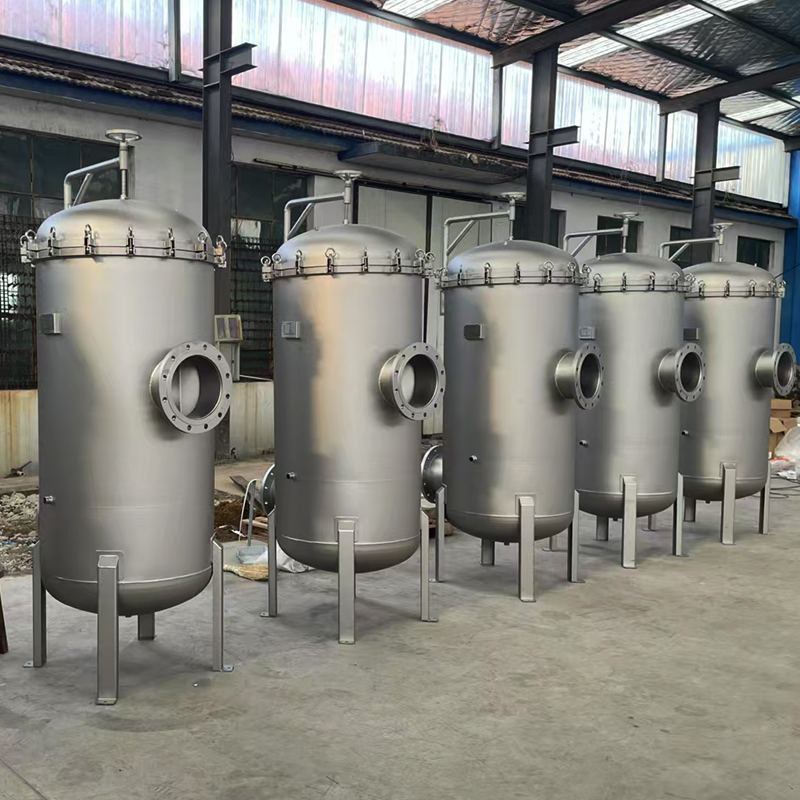
Standard multi-cartridge housings rely on dozens of thin, 2.5-inch diameter filter elements. While effective for low-flow rates, scaling this approach up requires massive vessels, extensive piping networks, and grueling maintenance turnarounds where technicians must manually replace hundreds of elements.
A dedicated high-flow cartridge filter housing is engineered explicitly to accept large-diameter elements (typically 6-inch or 6.5-inch outer diameter) with an outside-to-inside flow path. This specialized geometric configuration changes everything:
Massive Throughput in a Small Footprint: A single 60-inch high-flow cartridge can handle up to 500 gallons per minute (GPM) or roughly 113 m³/h. Consequently, a high-flow vessel housing just a few elements can replace a traditional cartridge vessel containing up to 30 to 50 standard filters.
Minimized Capital Expenditure (CAPEX): Smaller housing diameters translate to less structural steel, smaller footprint requirements on the factory floor, and reduced initial piping installation costs.
Rapid Maintenance (OPEX Reduction): Instead of spending an entire shift changing out traditional filters, a high-flow housing can be serviced in under 15 minutes due to the drastically lower element count and tool-less closure mechanisms.
When vetting a high flow cartridge filter housing manufacturer, you must look beyond the price tag. You are purchasing a pressurized process vessel. True manufacturing expertise is revealed in the mechanical design and raw material sourcing.
Industrial fluids are rarely gentle. Depending on your chemistry, your manufacturer must offer robust material options optimized for your specific corrosion profiles:
Stainless Steel 304L & 316L: The gold standard for industrial water treatment, food and beverage, and general chemical applications. Ensure the manufacturer uses the low-carbon “L” variants to prevent chromium depletion during welding, which can lead to intergranular corrosion.
Super Duplex & Exotic Alloys: For aggressive high-salinity applications like seawater reverse osmosis (SWRO) pre-filtration, premium alloys or specialized internal coatings are mandatory to prevent pitting and crevice corrosion.
FRP (Fiberglass Reinforced Plastic) & UPVC: For highly corrosive chemical lines or coastal desalination plants where metal structures fail rapidly, advanced non-metallic composites offer absolute immunity to rust.
Operating a high-flow system means dealing with significant kinetic energy and pressure variables. A reputable high flow cartridge filter housing manufacturer must possess the capabilities to design, build, and stamp vessels according to the ASME Section VIII, Division 1 Code (or equivalent regional standards like PED in Europe).
An ASME-certified vessel guarantees that the wall thickness, flange ratings, welding quality, and non-destructive testing (NDT) protocols conform to strict safety standards, minimizing the risk of catastrophic pressure failures.
The most common point of failure in poorly manufactured housings is fluid bypass. If a cartridge does not seat perfectly against the tubesheet, unfiltered liquid will bypass the media, contaminating your downstream system.
Precision Machined Tubesheets: Look for manufacturers that utilize CNC-machined tubesheets with tight tolerances to ensure O-ring seals (such as Code 3, Code 7, or specialized high-flow plug styles) snap perfectly into place.
Optimized Flow Distribution: The inlet nozzle must be strategically positioned or paired with an internal baffle plate. This dissipates the high-velocity incoming fluid, preventing the raw force of the stream from damaging or misaligning the filter elements inside.
An expert manufacturer won’t just sell you a standard catalog item; they will evaluate your facility’s spatial constraints and workflow ergonomics to recommend either a vertical or horizontal vessel alignment.
| Engineering Metric | Vertical High Flow Housings | Horizontal High Flow Housings |
| Footprint Requirement | Minimal floor space; utilizes vertical clearance. | Requires more floor space but zero overhead clearance. |
| Cartridge Accessibility | Requires ladders or overhead platforms for 40″/60″ filters. | Ergonomic, waist-height access directly from the shop floor. |
| Element Length Suitability | Ideal for 20″ and 40″ configurations. | Highly recommended for 60″ elements to prevent lifting strain. |
| Residual Liquid Drainage | Excellent gravity drainage from the vessel base. | Requires dedicated low-point drains due to horizontal orientation. |
At Macrokun Mesh, we do not view filter housings as simple metal tanks. We view them as the critical structural shell that protects your process purity. Leveraging our deep-rooted heritage in industrial mesh engineering, fluid mechanics, and precision fabrication, Macrokun Mesh manufactures high-flow cartridge filter housings that set the industry benchmark for durability and hydraulic efficiency.
Precision-Engineered Fluid Dynamics: Our backgrounds in mesh structures give us unparalleled insights into pressure drops ($\Delta P$) and fluid behavior. Every Macrokun high-flow housing features an optimized interior geometry that ensures uniform fluid distribution across all pleated elements, extending cartridge life by up to 30% compared to generic alternatives.
Industrial-Grade Welding and Finishing: Our certified welders utilize advanced TIG/MIG techniques. Every stainless steel vessel undergoes rigorous pickling, passivation, and optional internal/external mirror polishing or bead blasting. This smooth finish eliminates microscopic crevices, preventing bacterial colonization and particulate accumulation.
Ergonomic, Operator-First Closures: We understand that time spent on maintenance is lost revenue. Our housings are equipped with heavy-duty swing-bolt closures, davit arms, or quick-opening hydraulic lids. This allows a single operator to open, service, and re-seal a multi-round vessel safely without needing specialized heavy tools.
Tailored Customization Matrix: We don’t force your piping blueprint to fit our catalog. Macrokun Mesh provides fully custom inlet/outlet nozzle orientations (flanged, ANSI, DIN, or sanitary clamp), custom mounting legs, multi-port configurations, and differential pressure gauge ports tailored exactly to your existing skid infrastructure.
Our standard and customized industrial configurations are engineered to handle diverse operational thresholds:
Vessel Materials: Stainless Steel 304, 304L, 316, 316L, Carbon Steel (epoxy coated), Duplex Alloys, or FRP/UPVC.
Element Capacity: Single-round (1 element) up to multi-round systems holding up to 20+ high-flow elements.
Compatible Filter Sizes: 20-inch, 40-inch, and 60-inch high-flow pleated cartridges (6-inch to 6.7-inch OD).
Maximum Flow Design Rates: Scalable from 100 GPM (22 m³/h) to over 10,000 GPM (2,270 m³/h) per vessel module.
Design Pressure Limits: Standard ratings at 100 PSI (6.9 Bar) and 150 PSI (10.3 Bar), with heavy-duty high-pressure configurations engineered up to 1440 PSI upon request.
Sealing Interface Material: EPDM, Viton (FKM), Buna-N, or Silicone to ensure total chemical compatibility with your process fluid.
Our high flow filter housings are actively deployed across the globe, protecting critical infrastructure and refined downstream machinery:
RO Pre-Filtration & Desalination: Safeguarding expensive polyamide reverse osmosis membranes from fine suspended solids, silt, and macro-particles.
Municipal & Industrial Wastewater: Providing final polishing and liquid clarification before effluent discharge or environmental reclamation.
Petrochemicals & Refineries: Handling high-throughput process water, completion fluids, amine sweetening loops, and cooling tower side-stream filtration.
Power Generation Facilities: Managing boiler feed water clarification and turbine condensate polishing loops to prevent scale formation.
Food, Beverage, & Biopharma: Providing sanitary-compliant pre-filtration for bulk process water, ingredient washing, and bulk ingredient clarification.
A: Yes. Our internal tubesheets and element seats are engineered with universal adaptor dimensions. Whether you utilize 3M CUNO High Flow, Pall Cor規, Parker ParMax, or generic high-flow pleated elements, our vessels provide a perfect, bypass-free sealing interface.
A: Thanks to our wide hydraulic manifolds and optimized internal flow distribution plates, the clean pressure drop across our empty housing is exceptionally low—typically less than 1 to 2 PSI (0.07 to 0.14 Bar) at maximum design flow velocity.
A: Absolute reliability is our baseline. Upon request, Macrokun Mesh provides full QA/QC documentation packages, including hydrostatic pressure test reports, radiographic weld testing (X-ray), dye penetrant inspections, and material mill test certificates (MTCs).
A: If you have strict floor space constraints but ample overhead room, a vertical design is best. However, if you are running 60-inch filters, a horizontal housing is highly recommended; it allows operators to pull the heavy, saturated elements out horizontally at waist height, greatly improving plant safety and speed.
When you are filtering thousands of gallons of liquid per minute, your choice of hardware dictates your plant’s efficiency. A sub-par filter vessel can introduce structural risks, frequent leaks, and costly hydraulic resistance.
Partnering with an elite high flow cartridge filter housing manufacturer like Macrokun Mesh guarantees that your system is backed by precision engineering, superior materials, and a deep understanding of fluid dynamics. We don’t just manufacture containment vessels; we build long-term reliability directly into your fluid processing line.
Ready to optimize your flow capacity and future-proof your filtration system? Contact the technical engineering team at Macrokun Mesh today to receive a detailed engineering consultation, a custom dimensional drawing, or a fast project quote. Let’s build a cleaner, more efficient industrial future together.
Pre: 15um Reusable Pool Filter Bag Polyester/PE/PP Pocket Filter Liquid Filter Bag

MACROKUN has established long-term and stable cooperative relations with many transportation companies such as China Post, DHL, FEDEX, USPS, UPS, etc. Of course, MACROKUN can also provide air and sea transportation. The powerful logistics system enables all MACROKUN'S Printing Mesh, Filter Mesh and Filter Bags and so on to be easily and efficiently transported to any place. For quotes and inquiries, please email our sales team.


 Screen Printing Supplies
 Filter Mesh
 Filter Bag
 Liquid Filter Cartridges
 Filter Housing