
In the demanding world of industrial manufacturing, chemical processing, and wastewater treatment, maintaining fluid purity is paramount. Contaminants can damage expensive downstream equipment, compromise product quality, and lead to costly operational downtime. When it comes to efficient, high-capacity, and cost-effective liquid filtration, the single bag filter housing remains the industry workhorse.
However, selecting the right filter vessel is not a “one-size-fits-all” decision. A housing that is improperly sized or made from incompatible materials can result in frequent bag failures, excessive pressure drops, or even catastrophic leaks.
As a leading developer of precision filtration solutions, Macrokun Mesh has engineered this comprehensive guide to help you navigate the technical nuances of selecting a single bag filter housing tailored precisely to your operational demands.
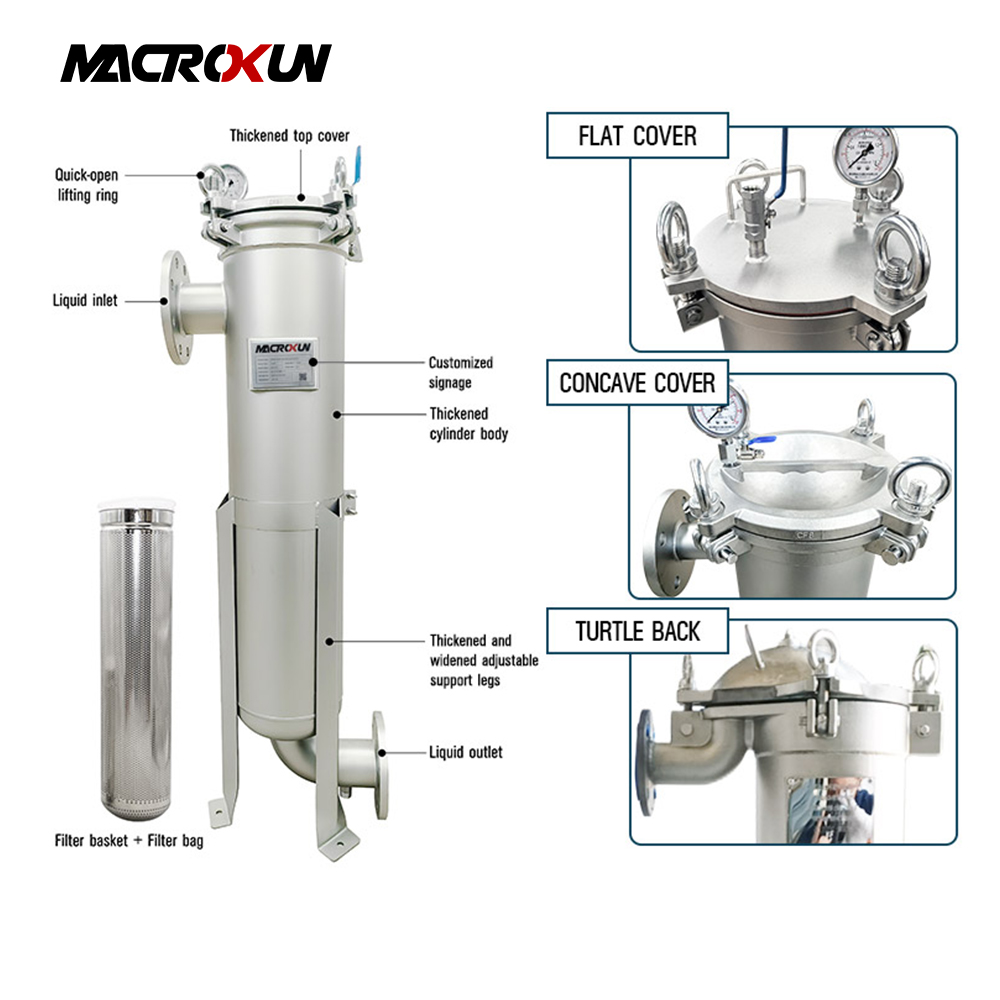
At its core, a single bag filter housing is a pressure vessel designed to hold a single replaceable filter bag. The fluid enters through the inlet (typically located at the top or side), passes through the filter bag from the inside out, and exits through the outlet at the bottom or side.
       [ Fluid Inlet ]
             │
     ┌───────▼───────┐
     │  ┌─────────┐  │
     │  │ Filter  │  │  <-- Contaminants trapped inside bag
     │  │  Bag    │  │
     │  └─────────┘  │
     └───────┬───────┘
             │
       [ Clean Outlet ]
A professional-grade housing consists of several critical components:
The Vessel Body: Usually constructed from high-tensile stainless steel to withstand significant system pressures.
The Internal Support Basket: A perforated metal basket that supports the filter bag against the hydraulic force of the fluid flow, preventing bag rupture.
The Cover/Lid: Equipped with various closure mechanisms (such as swing bolts or quick-open V-clamps) to allow for rapid bag change-outs.
Seals and O-Rings: Elastomeric components that ensure a leak-proof seal between the lid, housing, and the bag collar.
To find the optimal single bag filter housing, you must look past the price tag and analyze the specific thermodynamics and chemistry of your process line. Here are the core metrics you must evaluate:
Flow rate determines the physical size of the housing you require. A common mistake is sizing the housing solely based on pipe size. Instead, you must calculate the maximum gallons per minute (GPM) or cubic meters per hour ($m^3/h$) your system demands.
Furthermore, fluid viscosity plays a massive role. Water flows easily, but viscous liquids like resins, paints, or heavy oils require larger surface areas and slower velocities to pass through the same micron rating without blinding the filter.
Every single bag filter housing is rated for a maximum allowable working pressure (MAWP) and temperature.
Standard Applications: Standard commercial housings often handle up to 100–150 PSI.
High-Pressure Environments: For critical chemical or oil/gas applications, you may require heavy-duty vessels built and stamped according to ASME Section VIII standards, capable of handling 300+ PSI.
The materials of construction must be completely inert to the fluid being filtered.
304 Stainless Steel: Excellent for water, food and beverage applications, and mild chemicals.
316 Stainless Steel: Offers superior corrosion resistance, making it the gold standard for pharmaceutical, marine, and highly acidic chemical processing.
Carbon Steel: Often used for non-corrosive petroleum products or lubricants where cost optimization is required.
How often your operators need to change the filter bag should dictate the type of lid closure you select for your housing.
┌───────────────────┬──────────────────────────────────┬─────────────────────────────────┐
│ Closure Type      │ Pros                             │ Cons                            │
├───────────────────┼──────────────────────────────────┼─────────────────────────────────┤
│ Swing Bolt        │ Extremely robust, high-pressure  │ Takes longer to open; requires  │
│                   │ safety rating.                   │ tools.                          │
├───────────────────┼──────────────────────────────────┼─────────────────────────────────┤
│ Quick-Open Clamp  │ Fast, tool-free bag changes;     │ Lower pressure limits compared  │
│                   │ minimizes downtime.              │ to heavy swing bolts.           │
├───────────────────┼──────────────────────────────────┼─────────────────────────────────┤
│ Threaded / Screw  │ Compact design, ideal for small  │ Can bind if threads are contaminated│
│   Cap             │ or low-flow systems.             │ by the process fluid.           │
└───────────────────┴──────────────────────────────────┴─────────────────────────────────┘
When liquid flows through a clean single bag filter housing, there is always an initial restriction called the clean pressure drop. As the filter bag collects dirt, the restriction increases, causing the upstream pressure to rise.
To ensure an efficient system:
Keep Initial $\Delta P$ Low: Design your system so that the initial clean pressure drop does not exceed 2 PSI. If your clean setup is already dropping 5–10 PSI, your filter bags will blind almost immediately, requiring constant maintenance.
Monitor Terminal $\Delta P$: Change out your filter bags when the differential pressure reaches 15–20 PSI. Running the system past this point risks pushing contaminants through the filter medium or causing a bag blowout.
Even with a premium single bag filter housing, operational variables can cause hiccups. Here is how to diagnose and fix the most common issues:
Bypassing: If you notice unfiltered particulates in your downstream product, the filter bag may not be sealing correctly against the housing seat. Ensure you are using the correct bag collar (plastic flange vs. steel snap-ring) compatible with your housing’s internal rim.
Premature Clogging: If bags are filling up too quickly, check for upstream process changes. An increase in organic load or a change in fluid temperature can cause particulates to agglomerate, blinding the filter mesh prematurely.
Lid Leaks: If fluid escapes from the top seal during operation, depressurize the vessel immediately. Inspect the O-ring for cuts, chemical degradation, or flattening. Replace the elastomer with a compound (Viton, EPDM, or Buna-N) that matches your chemical profile.
At Macrokun Mesh, we believe that industrial filtration is a science of precision. We don’t just manufacture housings; we design complete fluid purification solutions.
Our single bag filter housings are engineered with optimized internal fluid dynamics to minimize turbulence and pressure loss. By utilizing high-purity 304 and 316 stainless steel, combined with precision-welded internal support baskets, our vessels deliver unmatched reliability in the field.
Whether you need a compact side-entry vessel for a boutique paint line or a heavy-duty, ASME-compliant top-inlet housing for an industrial chemical plant, Macrokun Mesh delivers the manufacturing excellence your engineers demand.
Q: Can a single bag filter housing be used as a basket strainer?
A: Yes. By replacing the internal fabric filter bag with a heavy-duty, reusable stainless steel mesh lined basket, the housing easily converts into a basket strainer for removing large, coarse particulates.
Q: What is the difference between a side-inlet and a top-inlet housing?
A: Side-inlet housings are generally more economical and allow for flexible piping configurations. Top-inlet housings force the fluid over the top rim of the bag collar, ensuring a 360-degree compression seal that virtually eliminates any chance of fluid bypass.
Q: How often should I replace the internal support basket?
A: Stainless steel support baskets are built for long-term durability. However, they should be inspected during every bag change-out for mechanical deformation, corrosion, or mesh tearing. A compromised basket will fail to support the bag, leading to premature bag ruptures.
Investing in the right single bag filter housing is the definitive way to secure your product quality, safeguard your expensive machinery, and streamline your operational maintenance. By balancing your flow rates, chemical properties, and pressure curves, you can create a seamless, high-efficiency filtration loop.
Stop guessing when it comes to fluid purity. Let our engineering team help you specify the exact vessel for your industrial blueprint.
[Contact Macrokun Mesh Today to Request a Technical Quote on Our Premium Stainless Steel Housings]
Pre: Multi Bag Filter Housing for Industrial High-Flow Liquid Filtration
Next: Single Bag Filter Housing for Reliable Industrial Liquid Filtration

MACROKUN has established long-term and stable cooperative relations with many transportation companies such as China Post, DHL, FEDEX, USPS, UPS, etc. Of course, MACROKUN can also provide air and sea transportation. The powerful logistics system enables all MACROKUN'S Printing Mesh, Filter Mesh and Filter Bags and so on to be easily and efficiently transported to any place. For quotes and inquiries, please email our sales team.


 Screen Printing Supplies
 Filter Mesh
 Filter Bag
 Liquid Filter Cartridges
 Filter Housing