
In high-volume liquid processing, fluid dynamics dictate your bottom line. Whether you are scaling up a municipal desalination facility, optimizing an oilfield injection system, or protecting expensive reverse osmosis (RO) membranes in a chemical plant, a single process bottleneck can paralyze operations.
To handle massive flow rates while minimizing space constraints, modern industries have heavily shifted from traditional standard-diameter cartridges to advanced, large-diameter high flow filter housings. However, a housing is far more than a pressurized container; it is a critical piece of flow-distribution machinery. An improperly designed vessel can suffer from mechanical bypass, localized hydraulic turbulence, and accelerated structural fatigue.
Choosing the right partner who understands both mechanical vessel fabrication and complex fluid acoustics is essential. This guide covers the technical specifications, flow alignments, and critical engineering choices you must consider when sourcing industrial high flow filter housings.
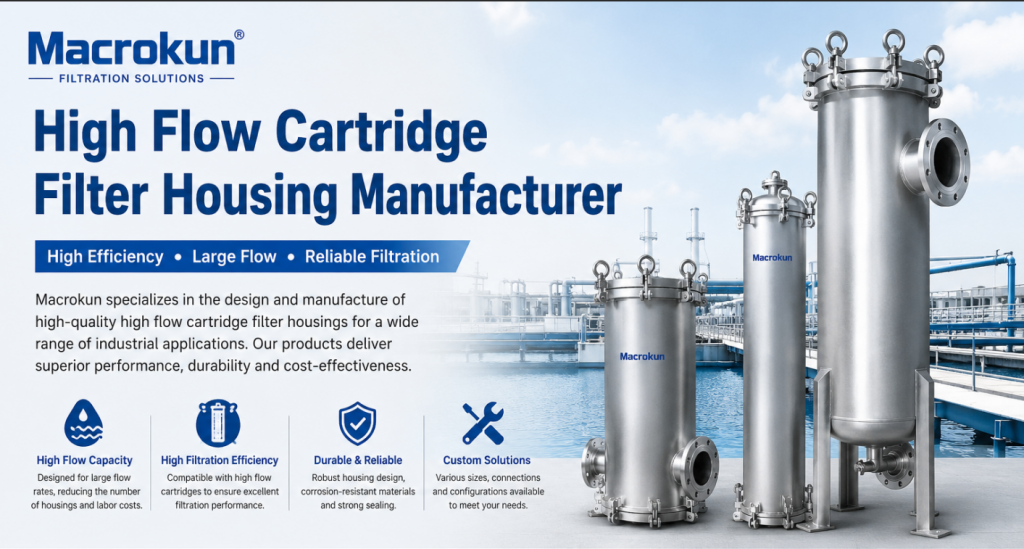
Traditional cartridge filtration systems rely on a cluster of small, 2.5-inch outer diameter (OD) filters. As throughput demands increase, a traditional vessel must expand horizontally and vertically, holding dozens or even hundreds of thin elements. This method creates several challenges:
High Total Cost of Ownership (TCO): Changing 100 individual filter cartridges takes hours of manual labor, creating long periods of process downtime.
Elevated Sealing Risk: Each filter element represents two sealing points (O-rings). In a 50-round housing, that equals 100 potential paths for unfiltered fluid to bypass the media.
Massive Plant Footprint: Traditional multi-round vessels require substantial floor space and heavy structural support skid layouts.
Advanced high flow filter housings solve these challenges by utilising large-diameter elements (typically 6-inch to 6.7-inch OD) with a unique inside-out or outside-in pleated geometry.
[Traditional Cartridge Housing]  --> Requires 40-100 slim elements --> High footprint, slow maintenance.
[High Flow Filter Housing]       --> Requires 1-7 large-diameter elements --> Compact footprint, 15-min change-out.
A single 60-inch high flow cartridge can manage fluid volumes up to 500 GPM (Gallons Per Minute) or roughly $114 m^3/h$. By packing this immense capacity into fewer elements, a high flow vessel reduces the physical space needed by up to 50% compared to traditional housings handling identical flow rates.
A professional manufacturer will never offer a one-size-fits-all product line. Industrial fluid networks demand a precise layout assessment based on headroom, floor space, and operator safety.
Vertical systems are the default choice when clean room floor space or skid real estate is at a premium.
Pros: Compact footprint; excellent gravity-assisted draining for low-viscosity fluids.
Cons: Replacing 40-inch or 60-inch heavy, water-logged elements requires significant overhead clearance. Operators often need scaffolding, ladders, or overhead cranes to lift elements vertically out of the vessel shell.
For heavy-duty, multi-round configurations holding long elements (40” or 60”), horizontal arrangements are highly recommended.
Pros: Unmatched ergonomics. The swing-bolt lid opens sideways, and elements sit at waist height. A single operator can change out multi-round configurations in minutes without any climbing or specialized lifting machinery.
Cons: Larger horizontal footprint across the skid.
| Selection Parameter | Vertical High Flow Housings | Horizontal High Flow Housings |
| Space Constraints | Best for limited floor area, high headroom. | Best for limited headroom, ample floor area. |
| Ergonomics & Safety | Requires vertical lifting of heavy elements. | Waist-height access; safer cartridge extraction. |
| Preferred Element Length | Ideal for 20″ and 40″ lengths. | Strongly recommended for 60″ lengths. |
| Maintenance Turnover | Moderate (depends on overhead accessibility). | Ultra-fast (tool-less access option). |
When evaluating technical quotes for a high flow filter housing, look beyond the initial cost (CAPEX). Review these mechanical details to ensure long-term reliability:
High-flow filtration systems operate under intense kinetic energy and hydraulic pressures. Ensure your manufacturing partner designs, fabricates, and tests vessels according to the ASME Section VIII Code (or European PED standards). An ASME-stamped vessel guarantees verified wall thickness, rigorous weld radiography, and certified hydrostatic pressure testing to handle sudden pressure spikes safely.
When fluid enters a housing at high velocities, the direct force can cause mechanical vibration, uneven flow distribution, or physical damage to the pleated media. Top-tier vessels feature an integrated internal baffle plate or a custom-positioned inlet nozzle. This breaks up the incoming fluid stream, distributing the velocity smoothly across the entire chamber to protect the elements.
If even 1% of your fluid passes around the edge of the filter element rather than through it, your downstream equipment is at risk. High flow housings require tight tolerances on the machined tubesheet. Look for heavy-duty shouldered seal plates or machined receiver cups designed for Code 3 (222 O-ring) or Code 7 (226 O-ring) configurations. These components click firmly into place, ensuring an airtight seal under varying temperatures.
At Macrokun Mesh, we do not build simple metal tanks. We manufacture high-performance fluid separation systems. Drawing on our deep expertise in precision wire mesh manufacturing and fluid dynamics, Macrokun Mesh produces high flow filter housings designed for excellent reliability, structural strength, and low pressure drops.
Optimized Hydraulic Architecture: Our background in precision mesh engineering gives us a deep understanding of fluid behavior. Every Macrokun vessel features an optimized internal layout that minimizes initial pressure drop ($\Delta P$), saving pumping energy and extending cartridge service life by up to 25%.
Industrial-Grade Metallurgy & Welding: We use premium low-carbon Stainless Steel (SS304L, SS316L), Duplex Steel, or specialized non-metallic composites (FRP/UPVC) for highly corrosive environments. Our certified technicians use advanced TIG/MIG welding techniques, followed by full chemical passivation and optional mechanical mirror polishing.
Operator-Focused Safety Closures: To keep your processes running smoothly, our larger multi-round systems feature heavy-duty swing eye-bolts, reliable davit arms, or quick-opening lids. These features allow a single team member to complete cartridge turnarounds safely without specialized tools.
Tailored Skid Integration: We match our equipment to your existing infrastructure. Macrokun Mesh provides fully customized connection ports (ANSI, DIN, or JIS flanges, sanitary clamps, or NPT/BSP threads), flexible orientation configurations, and pre-welded ports for differential pressure gauges and sampling valves.
Our industrial-grade high flow systems are designed to meet strict performance metrics across challenging process conditions:
Housing Material Matrix: Stainless Steel 304, 304L, 316, 316L, Carbon Steel with internal Epoxy/Rubber Lining, Super Duplex Alloys, FRP (Fiberglass Reinforced Plastic), or UPVC.
Element Configuration Limits: Ranges from single-round housings (1 element) up to large multi-round industrial vessels holding more than 20 high flow elements.
Cartridge Element Compatibility: Designed to accept standard 20″, 40″, and 60″ high-flow pleated cartridges with outer diameters ranging from 6 to 6.7 inches.
Volumetric Flow Rates: Scalable from 100 GPM ($22 m^3/h$) for localized lines up to 12,000+ GPM ($2,700+ m^3/h$) for large industrial modules.
Pressure & Temperature Performance: Standard options rated at 100 PSI (6.9 Bar) and 150 PSI (10.3 Bar). High-pressure custom vessels can be engineered up to 1,440 PSI for specialized deep-well injection applications.
Elastomeric O-Ring Selection: EPDM, Viton (FKM), Buna-N, Silicone, or PTFE-encapsulated seals to match your process chemistry.
Macrokun Mesh high flow filter vessels operate reliably around the world, protecting infrastructure and process purity across diverse sectors:
Seawater Reverse Osmosis (SWRO) Pre-Filtration: Positioned ahead of high-pressure pumps to capture silt, micro-particles, and suspended solids, protecting expensive polyamide membranes from fouling.
Petrochemicals & Gas Refineries: Used for high-volume filtration of process water, amine solution sweetening loops, glycol reclamation, and oilfield injection waters.
Power Generation Facilities: Managing bulk steam condensate polishing loops and cooling tower side-stream filtration to prevent mineral scaling on heat exchangers.
Municipal & Industrial Clean Water: Providing final polishing for industrial wastewater reuse networks and raw municipal intake water clarification.
Food, Beverage, & Pharmaceutical Production: Serving as bulk intake pre-filters for process water lines, bulk ingredient clarification, and utility water polishing.
A: Yes. We use universal geometric metrics for our internal tubesheets, guide tabs, and compression plates. Our vessels work seamlessly with major standard high-flow cartridges, including 3M High Flow, Pall Cor規, Parker ParMax, and generic elements, ensuring a perfect, bypass-free seal.
A: Initial clean pressure drop is caused by internal friction and directional changes. Macrokun reduces this by using wider inlet/outlet manifolds, oversized internal flow paths, and optimized baffle plates. Our empty housing drop typically stays under 1 to 2 PSI (0.07 to 0.14 Bar) at maximum design flow rates.
A: Yes, quality assurance is fundamental to our process. Every order can be accompanied by a comprehensive QA/QC documentation package. This includes raw Material Mill Test Certificates (MTCs to EN 10204 3.1), hydrostatic pressure test logs, X-ray radiographic weld reports, and dye penetrant testing records.
A: If your process involves high-salinity fluids, coastal environments, or aggressive acids (such as hydrochloric mixtures), stainless steel can suffer from crevice corrosion. In these cases, Fiberglass Reinforced Plastic (FRP) or UPVC housings provide absolute corrosion resistance at a lower capital cost.
When managing high fluid flow rates, your choice of housing hardware directly impacts your plant’s operational runtime and membrane replacement schedules. A poorly engineered vessel introduces risks of bypass leakage, mechanical failure, and frequent maintenance bottlenecks.
Partnering with an experienced manufacturer like Macrokun Mesh ensures your filtration system is backed by solid engineering, proven materials, and a deep understanding of fluid dynamics. We don’t just weld metal containers; we build reliable, long-term protection into your process lines.
Ready to optimize your flow layout or request an engineering quote? Contact the technical team at Macrokun Mesh today for dimensional drawings, custom material assessments, and project pricing. Let’s engineering an efficient, high-capacity future together.
Pre: How to Choose a High Flow Cartridge Filter Housing Manufacturer: The Ultimate 2026 Procurement Guide
Next: High Flow Cartridge Filter Housing for Industrial Liquid Filtration

MACROKUN has established long-term and stable cooperative relations with many transportation companies such as China Post, DHL, FEDEX, USPS, UPS, etc. Of course, MACROKUN can also provide air and sea transportation. The powerful logistics system enables all MACROKUN'S Printing Mesh, Filter Mesh and Filter Bags and so on to be easily and efficiently transported to any place. For quotes and inquiries, please email our sales team.


 Screen Printing Supplies
 Filter Mesh
 Filter Bag
 Liquid Filter Cartridges
 Filter Housing