
In mass-volume fluid processing, hydraulic efficiency dictates your operational bottom line. Whether managing pre-filtration pipelines for seawater reverse osmosis (SWRO), processing high-velocity chemical streams, or maintaining cooling tower side-streams in power generation plants, a single filtration bottleneck can trigger costly downtime.
To cope with escalating flow demands without expanding physical plant infrastructure, process engineers have structurally transitioned from traditional multifilament filter vessels to advanced high flow liquid filter housings. However, a high-flow vessel is not merely a steel tank; it is a critical hydraulic boundary layer. If designed poorly, it introduces mechanical bypass risks, extreme localized pressure drops ($\Delta P$), and elevated structural fatigue.
Sourcing your vessel from a manufacturer that integrates advanced mechanical fabrication with comprehensive fluid engineering knowledge is vital. This technical guide explores design methodologies, configuration matrixes, and crucial evaluation parameters required when engineering professional high flow liquid filter housings.
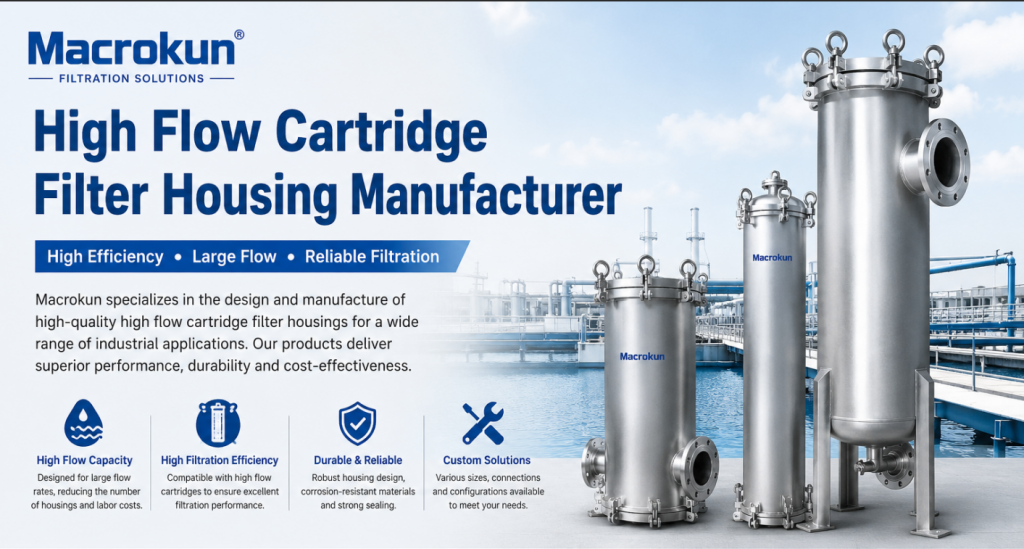
Traditional filtration configurations rely on arrays of small-diameter (2.5-inch OD) cartridges. When continuous process throughput demands scale up, traditional housings must scale out horizontally and vertically—often retaining dozens, if not hundreds, of slim elements inside a massive chamber. This classic arrangement creates definitive mechanical and financial limits:
The Bypass Proliferation Risk: Each individual cartridge requires distinct seat fittings and elastomeric O-rings. A 60-round traditional housing creates 120 separate micro-sealing points. Statistically, this elevates the vulnerability to alignment errors and raw fluid bypass.
Aggressive Maintenance Turnarounds: Manually unscrewing, removing, and reseating hundreds of contaminated filters consumes substantial labor hours, stalling plant productivity.
The Footprint Conundrum: Massive vessel diameters necessitate heavy structural skid framing, large physical floor coordinates, and intricate exterior manifold piping networks.
Modern high flow liquid filter housings rewrite this hydraulic footprint by utilizing large-format, high-surface-area elements—typically 6-inch to 6.7-inch outer diameters (OD) featuring structured inside-to-outside or outside-to-inside pleated flow orientations.
(Traditional Multi-Cartridge Vessel):
[Inlet] --> 60+ Small Elements (2.5" OD) --> Multiple Sealing Vectors --> High Maintenance [Outlet]

(High Flow Liquid Filter Housing):
[Inlet] --> 1 to 7 Large Elements (6.5" OD) --> Monitored Single Sealing Cups --> Minimal Footprint [Outlet]
A single 40-inch or 60-inch high-flow element can capture particulates at flow velocities reaching up to 500 Gallons Per Minute (GPM) or roughly 114 $m^3/h$. By replacing dozens of standard elements with a single high-flow unit, the footprint of the operational skid drops by up to 50%, while cartridge switch-out periods are compressed from several hours down to less than 15 minutes.
An expert manufacturer evaluates spatial envelopes, ceiling headers, and human logistics before recommending a structural layout for high flow liquid filter housings.
Vertical layouts are the preferred choice when floor space or modular skid real estate is constrained, but overhead clearance is extensive.
Engineering Advantages: Minimal physical floor footings required. Excellent gravity-assisted liquid evacuation from the lowest vessel boundary.
Maintenance Considerations: Extracting a spent 60-inch high-flow cartridge—which retains heavy, saturated particulate matter and residual water—requires significant overhead clearance. Operators frequently need service ladders, elevated platforms, or localized hoists to pull the element vertically clear of the tubesheet.
For high-capacity multi-round systems handling heavy process streams, a horizontal profile offers significant ergonomic and operational benefits.
Engineering Advantages: Superior operational safety. The heavy-duty blind flange or quick-opening cover swivels horizontally on a side hinge or davit arm. Elements sit at waist height, allowing a single operator to slide out spent cartridges effortlessly along internal support rails without extra lifting gear.
Maintenance Considerations: Requires a longer horizontal foot footprint on the industrial facility floor.
| Technical Parameter | Vertical High Flow Liquid Filter Housings | Horizontal High Flow Liquid Filter Housings |
| Footprint Optimization | Maximizes vertical space; ideal for tightly packed skids. | Occupies more horizontal floor area; requires side access. |
| Ergonomic Safety | High lifting strain during element changeout. | Low-profile, waist-height cartridge removal. |
| Element Capacity Suitability | Excellent for single-round and low multi-round limits. | Highly recommended for high-volume multi-round vessels. |
| Residual Fluid Drainage | Clean gravity discharge via standard base ports. | Requires specialized low-point drainage manifolds. |
When drafting procurement specifications for a high flow liquid filter housing, technical performance hinges on specific structural details rather than generic material listings:
Industrial liquid handling involves high kinetic energy, fluid acceleration, and pressure spikes. High-performance housings must be calculated, welded, and inspected in strict accordance with the ASME Section VIII, Division 1 Code (or European PED criteria). Certified ASME construction guarantees that the shell wall thicknesses, nozzle reinforcements, and flange ratings are tested using destructive and non-destructive methods (NDT) to prevent pressure boundaries from warping under cyclical stress.
When liquid enters a large chamber at high velocity, the localized impact force can create turbulent cross-currents, causing filter elements to vibrate or damaging the pleated synthetic media. Premier high flow liquid filter housings utilize internal flow distribution baffles or strategically offset inlet nozzles. This kinetic energy dissipation system guarantees that the liquid flow is uniformly distributed across the entire length of the filter element, preventing premature clogging and extending media lifetime.
Fluid bypass is the primary cause of downstream system contamination. If a cartridge does not lock tightly against the chamber divider, unfiltered liquid escapes into the clean stream. High-quality housings avoid flimsy spring mechanisms and instead utilize heavy-duty, CNC-machined receiver cups or shouldered sealing seats. These are tailored to snap securely around Code 3 (222 O-ring) or Code 7 (226 O-ring) adapters, ensuring an airtight seal under high forward differential pressures.
At Macrokun Mesh, we do not view filter housings as mere metal containers. We view them as the critical mechanical shell protecting your downstream purity. Leveraging our specialized foundation in precision wire mesh manufacturing, material metallurgy, and advanced fluid dynamics, Macrokun Mesh fabricates industrial-grade high flow liquid filter housings that optimize fluid distribution and provide exceptional service lifetimes.
Precision Hydrodynamic Internal Architecture: Our deep heritage in manufacturing industrial wire mesh gives us unique insights into pressure drop ($\Delta P$) behaviors. Every Macrokun vessel is engineered with expansive internal collector blocks and optimized manifolds, reducing empty-vessel pressure drop to less than 1–2 PSI, which directly lowers your system’s overall pumping energy costs.
Advanced Metallurgical Integrity: We source premium low-carbon Stainless Steels (SS304L, SS316L), Super Duplex alloys, or corrosion-immune FRP (Fiberglass Reinforced Plastic). All weld tracks undergo automated TIG/MIG processes, full pickling, chemical passivation, and meticulous internal surface sandblasting or mechanical polishing to eliminate crevice-corrosion pathways.
Tool-less Quick-Opening Closures: To minimize operational downtime, our large-scale high flow liquid filter housing systems are equipped with robust swing eye-bolt closures paired with spring-assisted lifting davits or heavy-duty hinges. This operator-first design ensures a complete cartridge changeout can be executed quickly by a single technician without requiring specialized heavy wrenches.
Comprehensive Technical Verification Packages: We maintain strict quality control standards. Every vessel shipped from Macrokun Mesh can be backed by a complete quality assurance dossier, including Material Test Certificates (MTC to EN 10204 3.1), radiographic weld inspection reports, hydrostatic pressure logs, and helium-leak tests.
Our industrial high flow liquid filter housings are designed to meet diverse operational parameters:
Available Alloys & Shell Materials: Carbon Steel (epoxy or rubber-lined), Stainless Steel 304/304L, Stainless Steel 316/316L, Duplex Steel, or FRP/UPVC for corrosive chemical applications.
Cartridge Accommodation Capacity: Configurable from single-round (1 element) up to heavy-duty multi-round models holding up to 20+ large-diameter cartridges.
Cartridge Sizing Variables: Designed for 20-inch, 40-inch, and 60-inch pleated high-flow elements with outer diameters (OD) spanning 6.0 inches to 6.7 inches.
Maximum Volumetric Flow Capacities: Ranging from 100 GPM (approx. 22 $m^3/h$) up to 12,000+ GPM (approx. 2,725 $m^3/h$) per vessel array.
Pressure / Temperature Operational Limits: Standard designs rated for 100 PSI (6.9 Bar) and 150 PSI (10.3 Bar). Custom, high-pressure industrial vessels can be calculated up to 1,440 PSI for deep-well exploration or specialized processes.
Nozzle and Fitting Variations: ANSI/DIN/JIS Flanged Connections, Sanitary Tri-Clamps, NPT/BSP Threads, along with dedicated ports for vent, drain, and differential pressure ($\Delta P$) gauges.
Macrokun Mesh high flow vessels are actively operating across global industrial networks, protecting critical infrastructure:
Seawater Reverse Osmosis (SWRO) Pre-Filtration: Protecting costly high-pressure pumps and polyamide membranes from particulate fouling, micro-sediments, and biological silt.
Chemical & Refining Infrastructure: Clarifying bulk chemical reagents, intermediate polymers, process cooling loops, amine gas sweetening solutions, and oilfield injection fluids.
Power Plant Utilities: Managing large steam condensate polishing loops and heat exchanger cooling streams to control mineral scaling.
Municipal Water Management: Providing final liquid clarification for industrial water reuse, effluent polishing, and high-volume drinking water networks.
Sanitary Liquid Processing: Serving as reliable bulk pre-filters for process lines in the food, beverage, and bulk ingredient sectors.
A: Yes. We design our internal receiver beds and alignment plates using universal industry spacing metrics. Our housings work seamlessly with standard large-diameter elements from major brands like 3M, Pall, Parker, or generic pleated high-flow cartridges, providing a perfect, bypass-free seal.
A: When fluid flows from the inside of the cartridge toward the outside, all filtered contaminants and solids are captured inside the element’s core cavity. During changeout, this design ensures that contaminants are pulled out cleanly with the cartridge, preventing debris from falling back into the clean chamber of the vessel.
A: Absolutely. For aggressive environments—such as high-chlorine industrial wastewater or low-pH process fluids—where stainless steel is cost-prohibitive, we supply carbon steel housings with heavy internal epoxy coatings, rubber linings, or specialized fluoropolymer layers (Halar/PTFE).
A: While our empty housings operate at a very low pressure drop (under 1–2 PSI), we recommend replacing the pleated internal elements when the differential pressure across the system reaches 20 to 25 PSI (1.4 to 1.7 Bar) to maintain optimal flow rates and pump efficiency.
When filtering thousands of gallons of liquid per minute, your choice of housing hardware dictates your plant’s overall efficiency. A sub-par filter vessel introduces structural risks, frequent leaks, and costly hydraulic resistance.
Partnering with an elite high flow liquid filter housing manufacturer like Macrokun Mesh guarantees that your system is backed by precision engineering, superior materials, and a deep understanding of fluid dynamics. We don’t just manufacture containment vessels; we build long-term reliability directly into your fluid processing line.
Ready to optimize your flow capacity and future-proof your filtration system? Contact the technical engineering team at Macrokun Mesh today to receive a detailed engineering consultation, a custom dimensional drawing, or a fast project quote. Let’s build a cleaner, more efficient industrial future together.
Pre: High Flow Cartridge Filter Housing for Industrial Liquid Filtration
Next: Multi Bag Filter Housing Manufacturer for High-Flow Industrial Filtration

MACROKUN has established long-term and stable cooperative relations with many transportation companies such as China Post, DHL, FEDEX, USPS, UPS, etc. Of course, MACROKUN can also provide air and sea transportation. The powerful logistics system enables all MACROKUN'S Printing Mesh, Filter Mesh and Filter Bags and so on to be easily and efficiently transported to any place. For quotes and inquiries, please email our sales team.


 Screen Printing Supplies
 Filter Mesh
 Filter Bag
 Liquid Filter Cartridges
 Filter Housing