
While both Nylon 6 and Nylon 66 filter meshes belong to the polyamide family and exhibit exceptional abrasion resistance, alkaline stability, and high elasticity, their distinct molecular blueprints dictate their ultimate performance thresholds:
Nylon 66 Filter Mesh features a higher melting point (260°C), superior thermal stability, lower moisture absorption, and improved acid resistance. It is the definitive choice for high-temperature processes, heavy-duty mechanical pressure filtration, and sub-micron technical screening.
Nylon 6 Filter Mesh delivers unmatched mechanical flexibility, outstanding structural elasticity, and extreme cost-efficiency. It remains the optimal solution for ambient hydraulic loops, industrial water treatment, municipal sewage filtration, and customizable flexible filter bags.
As a premier direct-to-factory manufacturer and global supplier, Macrokun provides fully customized Nylon 6 and Nylon 66 filtration solutions tailored to your precise industrial specifications.
In precision fluid separation, chemical processing, and industrial sifting, selecting the proper monofilament nylon filter mesh is critical to operational efficiency. Sourcing managers and fluid engineers frequently encounter the dilemma of choosing between Nylon 6 (PA6) and Nylon 66 (PA66). Making the wrong choice can lead to structural mesh deformation, premature pore clogging, or chemical breakdown under stress.
This guide analyzes the core scientific and mechanical differences between these two filtration media. Furthermore, it highlights how partnering with a dedicated factory manufacturer like Macrokun ensures you secure high-tier material suppliers, direct factory savings, and comprehensive OEM/ODM customization capabilities.
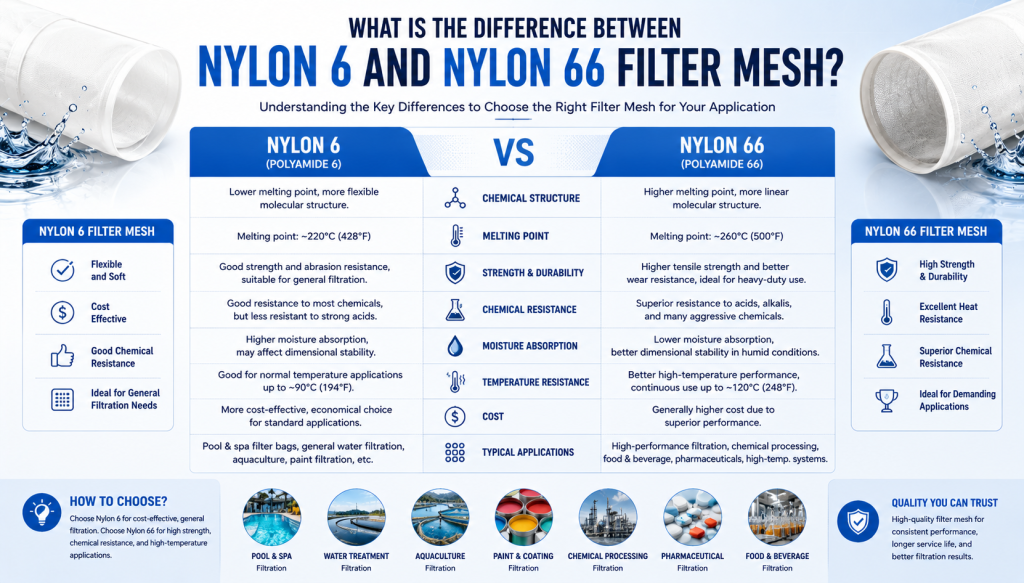
The operational variance between these two meshes is rooted deeply in their underlying polymer chains:
Nylon 6 (Polyamide 6): Synthesized via the ring-opening polymerization of a single monomer—caprolactam (containing 6 carbon atoms). The amide groups within the molecular chain align in a singular directional orientation. This results in a slightly lower hydrogen bond density, granting Nylon 6 unmatched structural flexibility, superior elasticity, and excellent mechanical resilience against sudden physical impacts.
Nylon 66 (Polyamide 66): Manufactured via the condensation polymerization of two separate monomers—hexamethylenediamine and adipic acid (each containing 6 carbon atoms, hence “66”). This symmetrical, dual-monomer alignment allows the molecular chains to pack tightly into a highly ordered crystalline lattice. This dense grid structure multiplies the internal hydrogen bond density, providing Nylon 66 with superior tensile strength, excellent dimensional stability, and exceptional resistance to thermal degradation.
In harsh industrial filtration, temperature determines mesh longevity. Nylon 66 boasts a high melting point of 255°C – 265°C, surpassing Nylon 6 (215°C – 225°C) by approximately 40°C. In active operations, Nylon 66 maintains structural integrity at continuous temperatures up to 125°C and withstands thermal spikes of 180°C. Conversely, Nylon 6 exhibits mechanical softening when exposed to environments above 95°C, risking pore deformation and bypassing particulates.
Filtration systems subject meshes to extreme fluid pressures and hydraulic shocks. Nylon 66 exhibits a significantly higher tensile modulus and yield strength than Nylon 6. In heavy-duty pressure filters, belt presses, or automated sifting decks, Macrokun’s Nylon 66 monofilament strands resist stretching under load. This guarantees that your micron rating remains perfectly uniform, eliminating structural distortion and preventing out-of-spec particulate bypass.
Polyamides are inherently hydrophilic due to their polar amide groups. Nylon 6 features an equilibrium moisture absorption rate of 2.5% – 3.5%, while Nylon 66 maintains a lower rate of 1.5% – 2.5%. When submerged long-term in aqueous liquids, Nylon 6 fibers experience swelling. This expanding fiber diameter reduces the effective opening size (mesh count accuracy), which chokes fluid flow rates and triggers steep pressure drops. Nylon 66 offers superior dimensional stability in liquid-submerged environments.
Both materials offer near-perfect immunity to hydrocarbons, greases, detergents, and heavy alkaline solutions. However, when exposed to trace organic acids (such as formic or acetic acid) or mild chemical cleaners, Nylon 66’s dense crystalline matrix acts as a superior barrier. It restricts acid molecule penetration, delivering an operational lifespan 20% to 35% longer than Nylon 6 under chemical stress.
The following data table displays the standard technical metrics utilized by factory engineers for material specification:
| Technical Property | Nylon 6 (PA6) Filter Mesh | Nylon 66 (PA66) Filter Mesh | Macrokun Engineering Selection Guide |
| Polymer Origin | Caprolactam Ring-Opening | Hexamethylenediamine + Adipic Acid | Determines ultimate physical limits |
| Melting Point | 215°C – 225°C | 255°C – 265°C | Nylon 66: Optimized for high-temp fluid processing |
| Continuous Working Temp | < 90°C | < 125°C | Nylon 66: Resists thermal degradation |
| Moisture Absorption (100% RH) | 8.5% – 9.5% | 7.0% – 8.0% | Nylon 66: Minimal swelling, precise pore lock |
| Elongation at Break | 35% – 50% (High elasticity) | 20% – 35% (High rigidity) | Nylon 6: Flexible processing; Nylon 66: Pressure stable |
| Micron Rating Capacity | 15μm – 1000μm | 5μm – 2000μm | Sub-20 micron precision requires Nylon 66 stability |
| Customization Versatility | Excellent for complex geometries | Superb for high-tension frames | Fully customizable by Macrokun Factory |
| Relative Cost Index | Economical Base (1.0) | Premium Tier (1.25 – 1.40) | Direct factory sourcing minimizes premium gap |
Scenario A: Automotive, Aerospace, & Heavy Industrial Pressure Filtration ➡️ Specify 【Nylon 66】
In fuel filtration loops, automotive under-the-hood screeners, and chemical belt presses, the mesh must withstand fluid temperatures exceeding 100°C alongside high pump pressures. Macrokun’s Nylon 66 factory mesh preserves its square weave aperture under heavy tensile load, ensuring flawless continuous operation without mechanical failure.
Scenario B: Sub-Micron Precision Lab & Medical Separation ➡️ Specify 【Nylon 66】
When working within critical 5μm to 20μm thresholds, mesh swelling cannot be tolerated. Additionally, medical and food-contact processes demand exceptionally low extractables. Utilizing ultra-pure polymer suppliers, Macrokun manufactures compliant Nylon 66 meshes that guarantee stable pore size and zero fluid contamination.
Scenario C: Bulk Municipal Water Sifting & Large-Scale Sewage Coarse Screening ➡️ Specify 【Nylon 6】
For ambient water sifting (below 50°C) and river intake sifting spanning 100μm to 500μm, Nylon 6 mesh provides an ideal balance of abrasion resistance and cost efficiency. It protects downstream equipment while remaining budget-friendly for large-scale municipal operations.
Scenario D: Custom Filtration Bags, Tubing, and Complex Geometric Elements ➡️ Specify 【Nylon 6】
If your process requires complex custom-shaped filter bags, rosin press sleeves, or pleated elements, Nylon 6’s high elongation-at-break prevents stitch tearing or edge cracking during ultrasonic welding, laser cutting, and sewing.
As a professional, large-scale industrial mesh manufacturer, Macrokun bridges the gap between raw chemical science and dependable field performance. Here is how our factory-direct infrastructure serves your business:
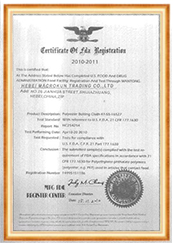
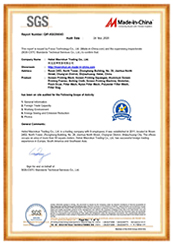
Top-Tier Global Suppliers: We source our premium Nylon 6 and Nylon 66 raw chips and monofilament yarns exclusively from world-leading chemical suppliers. This ensures batch-to-batch polymer consistency, precise molecular weights, and strict compliance with global industrial regulations (including FDA food-contact standards).
Advanced Direct-Factory Production: Operating our own specialized weaving factory equipped with high-precision imported looms and advanced thermal setting chambers, we eliminate middleman markups. Our direct-factory model passes significant cost savings to our clients while ensuring strict quality control over every square meter produced.
Unparalleled Customization (OEM/ODM Capabilities): No two filtration environments are identical. Macrokun offers extensive personalization options, including bespoke micron ratings, specific thread diameters, specialized roll widths, slit-to-width ribbons, laser-cut discs, and fully fabricated custom filter bags or injection-molded plastic filter elements.
A: A simple thermal burn test can differentiate the two. Carefully expose a small sample of the mesh to a controlled heat source. Nylon 6 melts quickly upon approaching the heat zone, forming a fluid, bead-like amber residue that drips rapidly due to its lower melting point (220°C). Nylon 66 requires a noticeably higher heat profile to melt (260°C); its melting process is slower, the bead formation is more viscous, and it exhibits self-extinguishing tendencies when removed from the flame. For definitive verification, Macrokun supplies full material batch test reports.
A: Technically yes, but economically and structurally no. While Nylon 66 outpaces Nylon 6 in heat and tensile limits, Nylon 6 remains preferred for processes demanding high elasticity and flexibility. It is less prone to stress-cracking when repeatedly folded or tensioned over complex geometric shapes, making it a highly reliable and cost-effective choice for flexible bags and ambient fluid operations.
A: Yes. Both Nylon 6 and Nylon 66 are naturally inert to non-acidic foodstuffs. Macrokun’s dedicated food-grade production lines utilize cleanroom slitting, ultrasonic washing, and strict post-weaving heat setting to ensure our fabrics are completely free of migrating chemical plasticizers, heavy metals, or loose fibers, meeting global compliance guidelines.
Balancing performance requirements against procurement budgets is the core challenge of industrial mesh sourcing. By understanding the structural differences between Nylon 6 and Nylon 66, you can prevent premature mesh failure and optimize fluid efficiency.
Whether your application demands the high-temperature strength of Nylon 66 or the cost-effective flexibility of Nylon 6, Macrokun’s direct-factory manufacturing, elite supplier network, and comprehensive customization capabilities ensure you receive the ideal filtration solution every time.
Contact Macrokun’s Technical Sales and Engineering Team today to request free product samples, comprehensive material data sheets, and competitive direct-factory volume quotes.
Pre: Single Bag Filter Housing for Reliable Industrial Liquid Filtration
Next: Industrial Bag Filter Housing Manufacturer for Liquid Filtration Systems

MACROKUN has established long-term and stable cooperative relations with many transportation companies such as China Post, DHL, FEDEX, USPS, UPS, etc. Of course, MACROKUN can also provide air and sea transportation. The powerful logistics system enables all MACROKUN'S Printing Mesh, Filter Mesh and Filter Bags and so on to be easily and efficiently transported to any place. For quotes and inquiries, please email our sales team.

 Screen Printing Supplies
 Filter Mesh
 Filter Bag
 Liquid Filter Cartridges
 Filter Housing