
Industrial screening is not simply about separating large particles from small ones. Every production line has an optimal opening size that balances throughput, classification accuracy, equipment protection, and operating efficiency. Selecting the wrong mesh size may reduce production capacity, increase maintenance costs, or compromise product quality.
Nylon Mesh 2000 Micron (2 mm) has become one of the most widely used coarse screening materials across industrial manufacturing because it offers an excellent balance between material flow and particle control. Compared with larger openings such as 3300 or 5000 microns, a 2 mm nylon mesh provides more accurate particle classification while maintaining high permeability. Compared with finer mesh fabrics, it reduces clogging and allows significantly higher production throughput.
At Macrokun Mesh, we manufacture high-quality nylon mesh for industrial screening, filtration, grading, and OEM fabrication. Whether you require mesh rolls, cut sheets, filter bags, cylindrical sleeves, or customized screening components, our engineering team can provide solutions tailored to your production process.
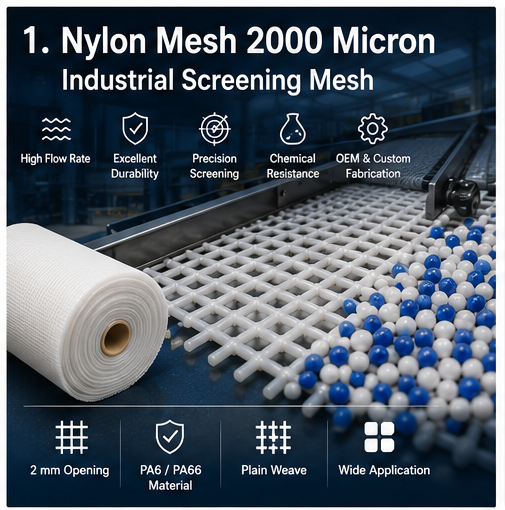
Many manufacturers initially believe that choosing the smallest possible opening will always improve product quality. In reality, this often creates unnecessary production problems.
A screen with an opening that is too small can:
On the other hand, a screen that is too large allows oversized particles to pass downstream.
A 2000 micron nylon mesh offers an excellent compromise by providing:
For this reason, many industrial screening systems use approximately 2 mm openings as their primary classification stage.
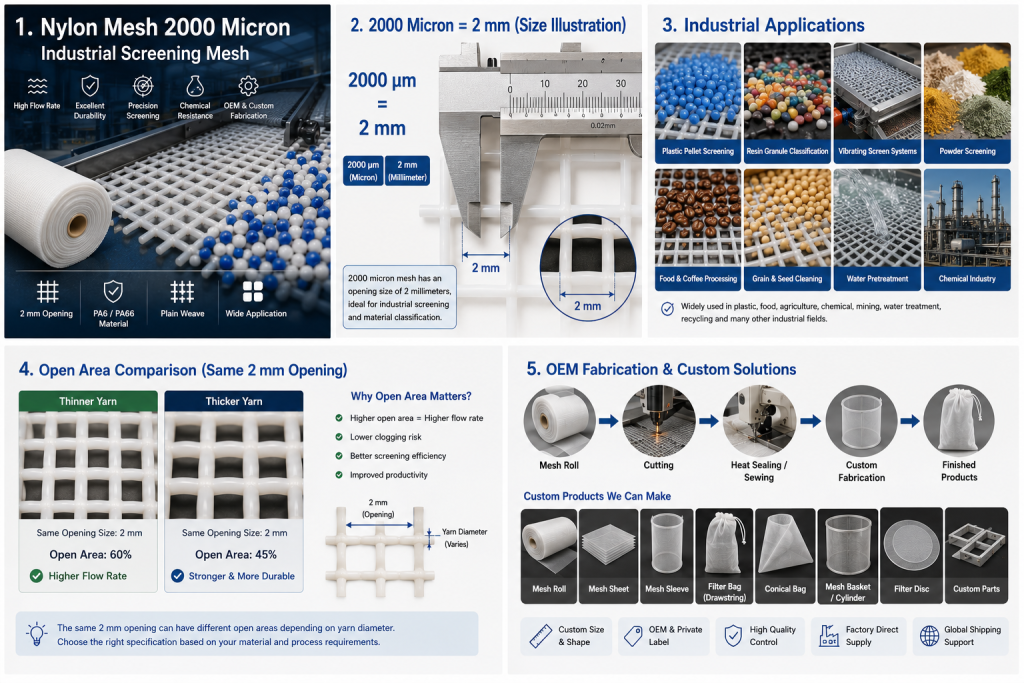
The opening size of 2000 microns is equivalent to:
The opening refers to the clear distance between adjacent yarns, not the yarn diameter itself.
Different manufacturers may produce 2000 micron nylon mesh using different yarn diameters. This means two products with the same nominal opening may provide different:
Therefore, selecting industrial mesh requires more than simply specifying the opening size.
| Property | Specification |
|---|---|
| Product Name | Nylon Mesh 2000 Micron |
| Opening Size | 2000 μm (2 mm) |
| Material | Nylon PA6 / PA66 |
| Construction | Monofilament Woven Mesh |
| Weave Type | Plain Weave |
| Color | White, Black or Customized |
| Supply Form | Roll, Sheet, Tube, Bag, Sleeve |
| Processing | Heat Cutting, Sewing, Ultrasonic Cutting |
| OEM | Available |
| MOQ | According to specification |
| Brand | Macrokun Mesh |
Actual technical parameters such as yarn diameter, open area, thickness, and tensile strength can be customized according to project requirements.
Unlike larger coarse meshes, a 2 mm nylon mesh provides better separation accuracy while maintaining fast production speeds.
It is ideal for separating:
Large openings allow liquids, air, or bulk materials to pass with minimal resistance.
This improves:
Industrial screening often involves continuous friction.
Nylon monofilament offers excellent resistance against:
This helps extend service life compared with many traditional woven fabrics.
Compared with stainless steel screening cloth, nylon mesh is significantly lighter.
Advantages include:
Nylon provides good resistance to many industrial chemicals including:
For aggressive acids or highly oxidizing chemicals, our engineers can recommend alternative materials where appropriate.
Large mesh openings make cleaning considerably easier than fine filtration cloth.
Most contamination can be removed through:
This minimizes downtime during production.
Plastic manufacturers frequently use 2000 micron nylon mesh to classify polymer pellets before extrusion, injection molding, or packaging.
The mesh effectively separates:
This helps improve product consistency while protecting downstream equipment.
Resin manufacturers require consistent particle sizes for stable production.
A 2 mm nylon screen can classify:
By removing oversized material, manufacturers reduce equipment wear and improve product quality.
Food manufacturers use nylon screening mesh for:
The smooth monofilament surface helps reduce product damage while allowing rapid drainage.
Coffee producers often require coarse screening before roasting.
A 2000 micron mesh assists with:
Many industrial powders contain occasional agglomerates.
Examples include:
A 2 mm nylon screen removes oversized lumps before downstream processing.
Farmers and agricultural equipment manufacturers use nylon mesh in:
The combination of high flow and durability makes it suitable for continuous agricultural operations.
One of the fastest-growing applications for 2000 micron nylon mesh is vibrating screening equipment.
Compared with metal mesh, nylon provides:
Many light-duty vibrating screens use nylon mesh where impact loads are moderate.
Although 2000 micron mesh is not designed for fine filtration, it performs well as a pre-screen.
Typical applications include:
Removing larger debris at the first stage helps extend the service life of downstream filter bags and cartridge filters.
Selecting the correct aperture is one of the most important decisions in any screening process. A smaller opening does not always produce better results, and a larger opening does not always improve productivity. The ideal mesh depends on the material being processed, the required separation accuracy, and the desired production throughput.
The table below compares several common nylon mesh opening sizes.
| Opening Size | Typical Application | Screening Accuracy | Material Flow |
|---|---|---|---|
| 500 μm | Fine powder filtration, paint, coatings | Very High | Moderate |
| 1000 μm | Food filtration, liquid pre-filtration, fine particles | High | High |
| 2000 μm | Plastic pellets, grains, powders, industrial classification | Excellent Balance | Very High |
| 3300 μm | Coffee beans, agricultural products, medium-coarse separation | Medium | Higher |
| 5000 μm | Aquaculture, debris removal, drainage | Low | Maximum |
For many industrial processes, 2000 micron nylon mesh offers the best balance between productivity and screening precision, making it one of the most versatile coarse screening fabrics available.
Both nylon mesh and stainless steel mesh are widely used in industrial screening, but they serve different purposes.
Compared with stainless steel, nylon mesh provides:
These characteristics make nylon an excellent choice for applications where flexibility and ease of handling are more important than extreme mechanical strength.
Stainless steel mesh is generally recommended for:
Rather than replacing stainless steel in every situation, nylon mesh complements it by offering a practical solution for medium-duty industrial screening.
Choosing the right supplier is just as important as selecting the correct mesh size. At Macrokun Mesh, we focus on helping customers improve screening efficiency through customized solutions rather than offering one-size-fits-all products.
Macrokun Mesh specializes in woven filtration and screening materials using advanced weaving equipment and precision quality control. Our production capabilities cover a wide range of nylon mesh specifications, from fine filtration fabrics to coarse industrial screening mesh.
Every production batch is monitored to ensure consistent opening size, weave quality, and dimensional stability.
Industrial customers often require more than raw mesh rolls. We provide customized conversion services, including:
Our engineering team can manufacture products based on customer drawings, samples, or technical specifications.
Many of our customers are filtration distributors, equipment manufacturers, and industrial brands. We provide comprehensive OEM services, including:
Every batch can be marked with:
This improves inventory management and product traceability.
Consistent quality is essential for industrial screening. Every batch of nylon mesh undergoes multiple inspections before shipment.
Only qualified nylon raw materials are selected for production. Material consistency directly affects strength, flexibility, and service life.
The mesh opening is measured at multiple locations to verify consistency across the entire roll.
Technicians inspect the woven fabric for:
Finished products are checked for:
Each order is packed to minimize contamination, moisture exposure, and transportation damage.
Macrokun Mesh offers flexible packaging solutions based on customer requirements.
Typical packaging options include:
International shipments are arranged by sea, air, rail, or express courier depending on order size and delivery schedule.
It is commonly used for industrial screening, plastic pellet separation, grain cleaning, powder classification, food processing, vibrating screens, and equipment protection.
Yes. A 2000 micron opening equals 2 millimeters.
It is generally used as a coarse pre-screen rather than a fine liquid filter. It removes larger particles before finer filtration stages.
Food-grade nylon mesh can be used in food processing applications when manufactured using compliant materials and appropriate production controls. Please specify your regulatory requirements when requesting a quotation.
For many light- and medium-duty screening applications, yes. However, stainless steel remains the preferred option for extremely high temperatures, heavy abrasion, or high-pressure environments.
Yes. It is widely used for classifying plastic pellets, resin granules, and recycled polymers, depending on pellet dimensions.
Nylon absorbs a small amount of moisture compared with polyester. This should be considered in applications requiring very high dimensional stability.
Service life depends on operating conditions, including material type, abrasion, cleaning frequency, UV exposure, and chemical environment. Proper selection and maintenance can significantly extend its lifespan.
Yes. In many applications, nylon mesh can be cleaned using water, mild detergents, or compressed air and reused multiple times.
Yes. Macrokun Mesh manufactures customized mesh bags, filter sleeves, tubes, discs, and other fabricated products based on customer requirements.
To provide an accurate quotation, please specify:
Yes. Sample availability depends on stock status and product specifications. Contact our sales team for sample requests.
Macrokun Mesh is more than a nylon mesh supplier—we are a manufacturing partner focused on helping customers optimize screening and filtration performance.
Our strengths include:
Whether you require standard 2000 micron nylon mesh or a fully customized screening solution, our engineering and sales teams are ready to support your project.
If you are looking for a reliable Nylon Mesh 2000 Micron manufacturer, Macrokun Mesh can provide customized solutions for industrial screening, food processing, plastic manufacturing, agriculture, aquaculture, and many other applications.
Simply send us the following information:
Our team will recommend the most suitable nylon mesh specification and provide a competitive quotation based on your project requirements.
Contact Macrokun Mesh today to discuss your 2000 micron nylon mesh project and receive professional technical support, OEM services, and factory-direct pricing.
Pre: Nylon Mesh 3300 Micron for Controlled Coarse Particle Screening

MACROKUN has established long-term and stable cooperative relations with many transportation companies such as China Post, DHL, FEDEX, USPS, UPS, etc. Of course, MACROKUN can also provide air and sea transportation. The powerful logistics system enables all MACROKUN'S Printing Mesh, Filter Mesh and Filter Bags and so on to be easily and efficiently transported to any place. For quotes and inquiries, please email our sales team.


 Screen Printing Supplies
 Filter Mesh
 Filter Bag
 Liquid Filter Cartridges
 Filter Housing