
Screening efficiency does not always improve by choosing the smallest possible opening. In many production lines, a very fine screen restricts flow, blocks too quickly and removes material that should remain in the process. A screen that is too coarse, however, may allow oversized particles or unwanted debris to pass.
Nylon mesh 3300 micron provides a practical middle ground for applications that require a controlled 3.3 mm opening. It is finer than common 5 mm screening mesh but considerably more open than fine liquid-filtration fabrics. This makes it suitable for sorting, washing, grading and protecting equipment in food processing, plastic production, agriculture, aquaculture and general industry.
Macrokun Mesh supplies nylon screening materials in rolls, sheets and custom-fabricated forms. Depending on the project, we can evaluate different yarn diameters, roll widths, colors, edge treatments and finished components.
Rather than offering one universal mesh for every use, we help customers match the opening, strength and construction to the material being processed.

A micron, also called a micrometer, is one-thousandth of a millimeter. Therefore:
3300 µm = 3.3 mm
It is also approximately:
The 3300 micron specification normally describes the clear opening between adjacent yarns. It does not describe the outside diameter of the yarn or the overall thickness of the fabric.
This distinction matters because two nylon screens can both have a 3.3 mm opening while providing very different performance.
One may use a relatively thin yarn to maximize open area and throughput. Another may use a heavier yarn to improve strength and dimensional stability. Both can be described as 3300 micron mesh, but they may behave differently under load.
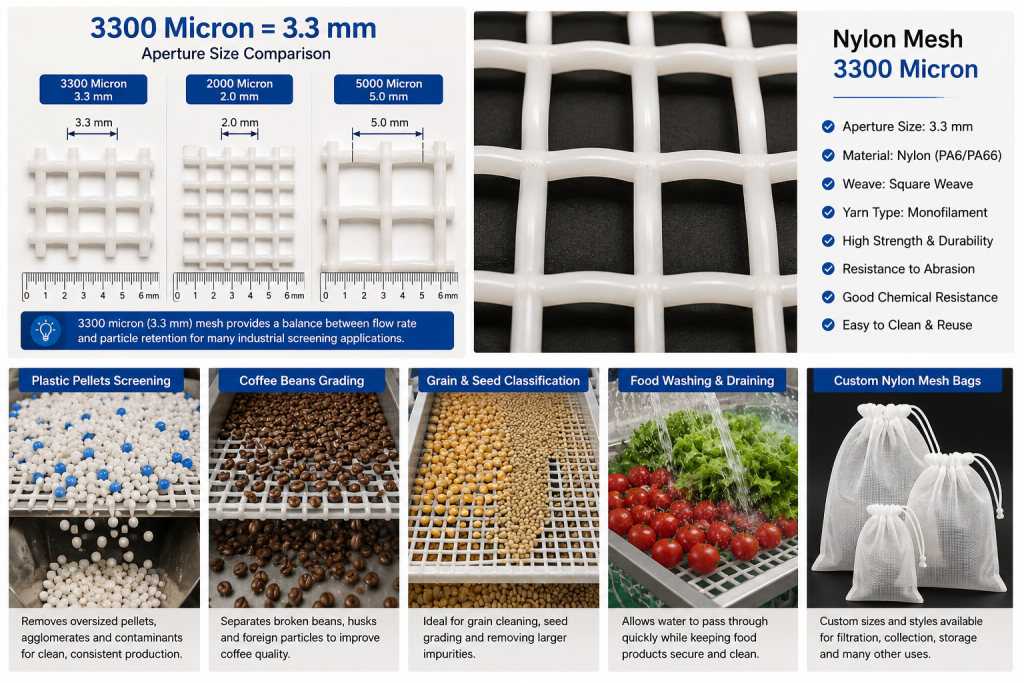
The table below represents the information buyers should confirm when requesting 3.3 mm nylon mesh.
| Specification | Description |
|---|---|
| Product | Nylon screening mesh |
| Nominal opening | 3300 µm |
| Metric equivalent | 3.3 mm |
| Material | PA6 or PA66 nylon |
| Yarn construction | Commonly monofilament |
| Weave style | Square or plain woven |
| Yarn diameter | Selected according to strength and open-area requirements |
| Open area | Depends on yarn diameter and weave |
| Color | Natural white, black or custom where available |
| Supply form | Roll, sheet or fabricated component |
| Edge treatment | Cut, heat-sealed, sewn, reinforced or framed |
| Custom products | Bags, sleeves, tubes, panels, baskets and shaped parts |
| Application | Coarse grading, separation, washing and equipment protection |
| Supplier | Macrokun Mesh |
| Order service | Wholesale, OEM and customized production |
A final specification should include more than the words “nylon mesh 3300 micron.” Buyers should also state the required width, yarn strength, finished form and operating conditions.
A 3.3 mm aperture can provide a useful balance between material retention and process capacity.
It may be selected when a 5 mm screen allows too much unwanted material to pass, but a 2 mm screen causes unnecessary restriction or frequent clogging.
This middle-size opening can help:
The correct opening depends on the smallest particle that must be retained—not simply the average particle size.
A common purchasing mistake is to compare the mesh opening only with a single particle measurement.
Real materials are rarely perfect spheres. Plastic flakes, plant stems, wood fragments and food particles may be long, flat, curved or irregular.
For example, a particle measuring 5 mm in length may still pass through a 3.3 mm square opening if its width and thickness are small enough. A round pellet measuring 3.5 mm may be retained more reliably because it cannot easily reorient itself through the opening.
When screening irregular material, buyers should evaluate:
Macrokun Mesh recommends testing representative material whenever separation accuracy is important. A small mesh sample can reveal more than a theoretical particle-size comparison.
The 3.3 mm opening provides more retention than a 5 mm mesh while maintaining much higher throughput than fine filtration cloth.
This makes it useful where the process needs screening rather than micron-level filtration.
Nylon screening is significantly easier to handle than many rigid metal screens. Large sheets and removable panels can be installed without heavy support structures in suitable applications.
Flexible mesh can conform to baskets, frames, cylinders and irregular equipment. It is also suitable for producing bags, sleeves and collection components.
Nylon is widely used where repeated movement and surface contact occur. A properly selected yarn construction can perform well in processes involving pellets, seeds and other rounded solids.
Sharp particles, however, can cut or damage polymer yarn. Applications involving broken glass, metal fragments or sharp mineral particles may require stainless steel mesh.
Many coarse nylon screens can be rinsed and reused. Their relatively large openings are easier to clean than very fine fabrics when the retained material is not strongly adhesive.
Nylon can be useful where metal contamination, electrical conductivity or contact between two metal surfaces is undesirable.
The material can be cut, sewn, reinforced and shaped into application-specific products. This allows customers to purchase a ready-to-install component rather than modifying roll material on site.
Plastic processing is one of the most relevant applications for 3.3 mm nylon mesh.
Pellet producers, compounders and recyclers may need to separate:
A 3300 micron screen can be evaluated when the acceptable pellet dimensions are smaller than the opening while larger clusters must be removed.
In virgin resin systems, screening can protect feeding and molding equipment from foreign objects or agglomerated pellets. A lightweight nylon panel may be installed in a hopper, transfer point or collection container when process conditions permit.
Recycled feedstock often contains more variation than virgin pellets. A coarse nylon screen can help separate larger contaminants before washing, drying or reprocessing.
The screen must be selected carefully because recycled material may include sharp fragments that can damage polymer mesh.
In water-assisted pellet handling, nylon mesh may be considered for drainage or product collection. The yarn strength, seam design and frame support must be matched to the combined weight of pellets and water.
A 3.3 mm screen can also be used as one stage within a multi-screen grading system. Material retained on one screen and passing through another can be classified within a defined approximate size range.
It should not be treated as a calibrated laboratory sieve unless the finished product has been manufactured and verified to the required test standard.
Food processors often need to separate ingredients without excessively restricting water flow.
Potential uses for 3300 micron nylon screening include:
A nylon screen can support produce during spraying or immersion washing. Water and small particles pass through while the main product remains on the mesh.
The yarn diameter and support structure should be selected according to the weight of the wet product.
A 3.3 mm opening may help remove smaller fragments or foreign particles from selected beans and coffee products. Suitability depends on the dimensions of the specific variety.
Before ordering large quantities, processors should test actual product because bean size and shape can vary by source, harvest and moisture level.
For some nuts and larger seeds, the opening can support preliminary grading or removal of broken pieces. It may also serve as a drainage screen during washing.
Food-contact suitability must be confirmed for the actual nylon resin, colorant, processing additives and finished construction.
Customers should specify:
The term “nylon” alone does not prove compliance with a particular food-contact regulation.
Agricultural materials commonly contain stems, leaves, husks, stones and broken product. A 3300 micron screen can be used as a preliminary separation stage where the product dimensions are appropriate.
Possible applications include:
The mesh should be supported adequately when processing heavy material. A large unsupported panel may sag, which can reduce screening efficiency and change the effective opening orientation.
For vibrating equipment, the fabric and fastening method must withstand continuous movement. Not every flexible nylon mesh is suitable for high-frequency industrial vibration.
Compared with 5000 micron mesh, the smaller 3.3 mm opening can retain smaller organisms and finer feed material.
Potential applications include:
The opening should be smaller than the minimum body dimension of the organism being retained. Behavior must also be considered because flexible organisms may pass through openings smaller than their apparent body width.
For long-term outdoor use, customers should discuss ultraviolet exposure. Standard nylon may lose appearance or mechanical performance after extended sunlight exposure.
Manufacturers can use coarse nylon bags and baskets to hold small components during washing, coating or surface treatment.
A 3.3 mm opening can allow cleaning liquid to circulate around parts while helping prevent components from leaving the container.
Applications may include:
The mesh material must be chemically compatible with the detergent, solvent or treatment bath. It must also withstand the weight and edges of the components.
Metal parts with sharp corners may require a heavier mesh or metal basket.
Open area strongly influences flow.
A screen with a 3.3 mm opening and a thinner yarn generally provides:
A screen with the same opening and a thicker yarn generally provides:
Neither construction is automatically better.
A lightweight screen may be ideal for washing vegetables, while a heavier fabric may be more appropriate for a reusable pellet collection bag.
The best choice depends on the process rather than the opening alone.
Although both are coarse screening products, they serve different separation goals.
| Selection factor | 3300 micron mesh | 5000 micron mesh |
| Opening | 3.3 mm | 5 mm |
| Relative retention | Higher | Lower |
| Relative flow potential | Moderate to high | Very high |
| Typical solids | Pellets, beans, seeds and medium fragments | Leaves, large debris and larger organisms |
| Clogging tendency | Slightly higher | Lower |
| Grading precision | Better for medium-coarse material | Better for rough separation |
| Common positioning | Product sizing and controlled screening | High-throughput debris removal |
Choose 3300 micron when the process needs better control over medium-sized particles. Choose 5000 micron when maximum flow and large-object retention are more important.
A 2000 micron screen has a 2 mm opening and provides finer separation.
It may be preferable when:
A 3300 micron screen may be preferable when:
Testing multiple apertures is often the best way to select a screen for irregular materials.
Macrokun Mesh can evaluate PA6 and PA66 options according to production availability and application requirements.
PA6 is often selected for general screening because it offers a practical combination of flexibility, toughness and cost.
It may suit:
PA66 may be selected when greater dimensional stability or elevated-temperature performance is required.
However, fabric performance also depends on yarn diameter, weaving quality and the finished construction. Material grade should be evaluated as part of the complete product specification.
Polyester is another common polymer-screening material.
Nylon may be preferred for:
Polyester may be preferred for:
Neither material is universally superior. Chemical exposure, temperature, moisture and mechanical load should guide the decision.
Stainless steel is more suitable for high-temperature, high-load and highly abrasive processes.
Choose stainless steel when the application involves:
Choose nylon when the application benefits from:
Some systems use nylon mesh attached to a rigid metal frame, combining a lightweight screen surface with structural support.
Macrokun Mesh can evaluate custom conversion for customers who need a finished component rather than raw fabric.
Available configurations may include:
A drawing is strongly recommended for fabricated products. It should show dimensions, tolerances, seam positions, edge treatments and connection details.
Openings should remain reasonably uniform across the usable fabric area. Distorted openings can affect both retention and throughput.
Yarn diameter influences strength, open area and flexibility. It should be included in technical discussions whenever possible.
The usable width should meet the customer’s cutting or fabrication requirements. Edge sections may differ from the main woven area and should be considered when planning yield.
The yarns should remain in position during cutting, handling and installation. Coarse mesh can shift more easily than fine mesh if the construction is not stable.
For bags and sleeves, seams may fail before the mesh itself. Seam type, thread material and reinforcement should match the expected load.
Food, laboratory and sensitive industrial applications may require special handling and packaging. Customers should communicate cleanliness expectations before production.
Where required, packaging can identify product specification, production batch and quantity.
For a faster technical review, provide the following details:
This information allows Macrokun Mesh to evaluate the complete application rather than quoting a generic fabric based only on pore size.
Yes. A 3300 micron opening is equal to 3.3 millimeters.
No. Micron is a unit of opening size. Mesh count normally describes the number of openings per linear inch. A 3300 micron screen is a coarse material, while “3300 mesh” would imply an extremely fine material.
Yes. A 3.3 mm opening is smaller than a 5 mm opening, so it retains smaller particles.
It can be suitable for separating oversized pellets, clusters and contaminants, depending on the dimensions and shape of the acceptable pellets.
Potentially. Coffee-bean dimensions vary, so the actual product should be tested against the 3.3 mm opening before full-scale use.
Yes, in suitable grain and seed applications. The opening must be matched to the crop and the unwanted material being removed.
No. Fine powder will generally pass through a 3.3 mm opening. A finer screen or filter is required for powder retention.
Yes. Its open woven structure can support rapid drainage when the selected opening and open area are appropriate.
Many nylon mesh products can be washed and reused. Cleaning chemicals, water temperature and mechanical cleaning methods must be compatible with the mesh.
Macrokun Mesh can evaluate custom bags, sleeves, panels and shaped screening components based on the customer’s dimensions and application.
Food-contact options may be available, but compliance must be confirmed for the exact resin, color, finished product and destination market.
It may be used outdoors, but prolonged UV exposure can affect standard nylon. UV requirements should be stated during product selection.
There is no universal best yarn diameter. Thinner yarn increases open area, while thicker yarn generally increases strength. The choice depends on flow, load and service life.
Sample availability depends on the requested construction and stock status. Customers can contact Macrokun Mesh with their specification for evaluation.
Macrokun Mesh supplies filtration and screening materials for distributors, processors, equipment manufacturers and industrial users.
Our service includes:
Our goal is to provide a screen that works in the customer’s process—not simply a fabric with the correct number printed on its label.
Macrokun Mesh welcomes inquiries for nylon mesh 3300 micron, 3.3 mm nylon screening rolls and custom-fabricated mesh components.
Whether you need material for plastic pellets, food ingredients, agricultural products, water drainage or industrial equipment protection, our team can help evaluate the opening, yarn construction and finished format.
Send your required dimensions, application, quantity and operating conditions to Macrokun Mesh for a sample evaluation or commercial quotation.
Contact Macrokun Mesh today for customized 3300 micron nylon mesh, wholesale rolls and ready-to-install screening components.
Pre: Nylon Mesh 5000 Micron for Coarse Screening and Industrial Separation
Next: Nylon Mesh 2000 Micron for Precision Industrial Screening and Material Classification

MACROKUN has established long-term and stable cooperative relations with many transportation companies such as China Post, DHL, FEDEX, USPS, UPS, etc. Of course, MACROKUN can also provide air and sea transportation. The powerful logistics system enables all MACROKUN'S Printing Mesh, Filter Mesh and Filter Bags and so on to be easily and efficiently transported to any place. For quotes and inquiries, please email our sales team.


 Screen Printing Supplies
 Filter Mesh
 Filter Bag
 Liquid Filter Cartridges
 Filter Housing