
When a process needs to retain large particles while allowing water, air or product to pass with minimal resistance, a fine filter cloth is often unnecessary. A coarse woven screen can provide faster flow, easier cleaning and more practical separation.
Nylon mesh 5000 micron is a coarse synthetic screening material with an approximate opening size of 5 millimeters. It is commonly considered for aquaculture, food handling, agricultural screening, industrial separation, protective netting, filter bags, pipe screens and other applications where large debris must be separated from a flowing medium.

Macrokun Mesh supplies and develops nylon mesh products for international filtration and screening customers. For projects requiring a 5000 µm opening, our team can evaluate the required mesh construction, yarn diameter, roll width, open area, fabricated shape and operating conditions before recommending a suitable solution.
Customers can inquire about mesh rolls, sheets, cut panels, tubes, sleeves, filter bags and other converted components.
Nylon mesh is a woven synthetic fabric made from polyamide yarns. The yarns are arranged in a regular pattern to form controlled openings through which liquid, air or smaller materials can pass.
The term 5000 micron refers to an opening of approximately:
This is a relatively large opening compared with conventional filtration mesh. It should therefore be understood as a coarse screening material rather than a fine particle filter.
A 5000 micron nylon mesh will not retain fine sediment, microorganisms or micron-sized suspended solids. Its purpose is generally to catch larger pieces such as leaves, fibers, shells, food fragments, insects, plant material, packaging debris or aquatic organisms, depending on the application.
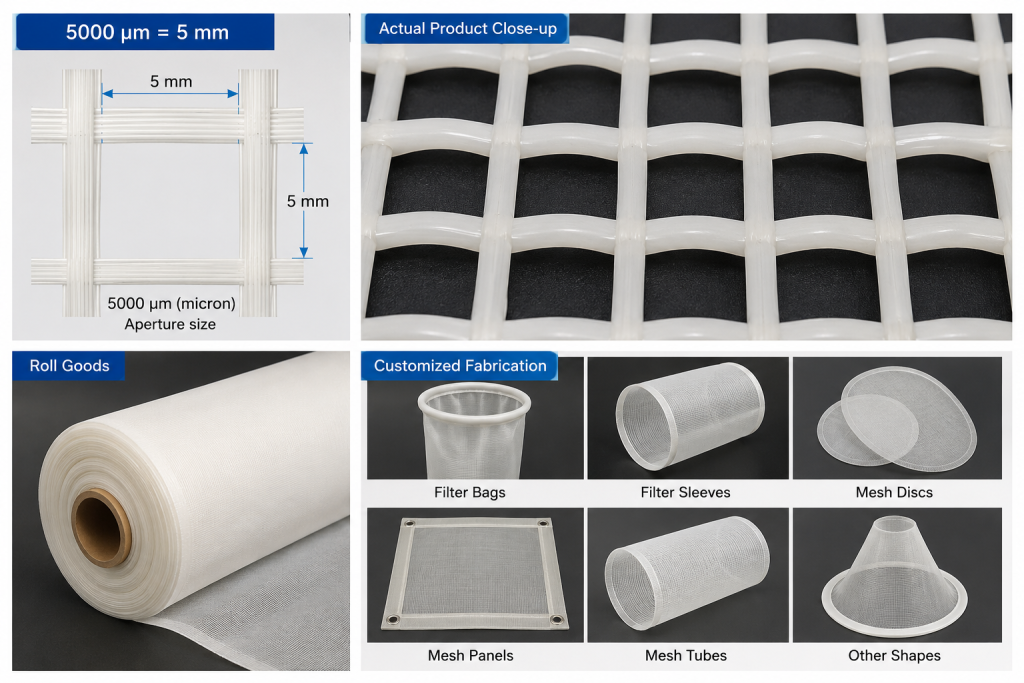
| Property | Typical or Custom Description |
|---|---|
| Product name | Nylon mesh 5000 micron |
| Nominal opening | Approximately 5,000 µm |
| Equivalent opening | Approximately 5 mm |
| Material | Nylon PA6 or PA66, subject to specification |
| Yarn type | Monofilament or application-specific construction |
| Weave | Typically square or plain woven |
| Form | Rolls, sheets, panels or fabricated components |
| Color | White, natural, black or customized |
| Width | Customized according to production availability |
| Roll length | Standard or customized |
| Edge treatment | Heat cut, ultrasonic cut, sewn or reinforced |
| Fabrication | Discs, bags, sleeves, nets, tubes and panels |
| Food-contact grade | Available only when specifically confirmed |
| Supplier | Macrokun Mesh |
| Order type | Sample evaluation, wholesale, OEM and custom production |
The exact open area, yarn diameter, fabric thickness and weight depend on the selected construction. A buyer should request a technical specification rather than purchasing by nominal opening alone.
No. This distinction is important.
5000 micron describes an opening size of approximately 5 mm. It is a coarse screen.
5000 mesh, in contrast, would normally imply an extremely high number of openings per linear inch and a very fine material. In practical woven filtration, the terms cannot be used interchangeably.
Search listings sometimes mix up micron size and mesh count. This can lead to serious purchasing errors. When requesting a quotation, state the requirement clearly as:
“5,000 µm nominal opening” or “approximately 5 mm square opening.”
It is also helpful to provide a drawing, sample or photograph of the current screen.
Nylon combines low weight, flexibility and useful mechanical strength. These characteristics make it suitable for many screening tasks where metal mesh would be unnecessarily heavy or rigid.
Coarse screens are often exposed to moving solids, repeated washing and mechanical handling. Nylon has good resistance to abrasion, which can help the screen withstand repeated contact with particles and equipment surfaces.
The service life still depends on yarn diameter, tension, particle sharpness and operating speed.
Compared with rigid metal screens, nylon mesh is easier to roll, fold, sew and fit around curved equipment. It can be made into bags, sleeves, cages, panels and removable screens.
This flexibility is valuable when the screen must be installed in tanks, pipes, baskets or irregular frames.
A 5 mm opening allows liquid or air to pass with relatively low resistance. When paired with an appropriate yarn diameter, the fabric can provide a large open area and rapid throughput.
This makes the mesh useful as a protective screen or first-stage separator upstream of a finer filter.
Nylon screening is easier to transport and install than many metal alternatives. Large panels can often be handled without heavy lifting equipment.
In many coarse-screening applications, nylon mesh can be removed, rinsed and reused. The correct cleaning method depends on the captured material and the chemical environment.
Nylon mesh can be cut and converted into many forms. Macrokun Mesh can evaluate fabrication options for customers who need more than a standard roll.
Aquaculture systems often require screens that allow water to circulate while retaining fish, larvae, feed particles, plants or other organisms of a defined size.
A 5 mm nylon mesh may be considered for:
The actual opening must be selected according to the smallest organism or object that must be retained. Flexible nylon mesh can be fitted around frames or formed into removable screen panels.
Nylon exposed outdoors should be evaluated carefully because prolonged ultraviolet exposure can reduce service life unless a UV-stabilized grade is selected.
Coarse nylon mesh can separate larger pieces from liquids or bulk ingredients. Possible applications include:
For direct food contact, buyers should request the relevant material declaration and confirm that the complete finished product meets the regulations applicable to the destination market.
A general nylon designation does not automatically confirm food-contact compliance.
Agricultural operations use mesh for sorting, containment and protection. A 5000 micron nylon screen can be evaluated for:
The fabric construction should be chosen according to the weight of the product and the mechanical load placed on the mesh.
Many filtration systems benefit from a coarse first stage that removes large debris before the liquid reaches a finer filter bag, cartridge or membrane.
A 5000 micron screen may protect downstream equipment from:
Removing these materials at the inlet can reduce premature blockage of finer filters and simplify maintenance.
However, a coarse nylon mesh is not a replacement for a rated fine filter when the process requires small-particle control.
Nylon mesh can be fabricated into sleeves, covers or baskets for pipe openings and drains. It can prevent larger objects from entering a system while allowing water to pass.
Potential uses include:
The mesh must be secured properly. An incorrectly fitted screen may collapse, move or allow debris to bypass the edges.
Coarse mesh bags are convenient when retained material must be lifted out and removed. Applications may include:
Macrokun Mesh can evaluate sewn and welded constructions according to the yarn type, bag dimensions and operating conditions.
Although 5000 micron mesh is too coarse for conventional analytical membrane filtration, it can be used in laboratories for:
Researchers should record the actual measured opening and mesh construction to maintain repeatability.
Nylon mesh may also serve as a lightweight guard around equipment, containers or product-handling areas. It can provide physical separation without completely blocking airflow or visibility.
This type of use requires an assessment of load, impact resistance and safety requirements. Standard filter mesh should not be treated as certified fall protection or personnel safety netting unless it has been designed and tested for that purpose.
Both PA6 and PA66 are used to manufacture nylon mesh, but they have different performance characteristics.
PA6 is widely used for general filtration and screening. It offers:
It is often suitable for general industrial, agricultural and food-handling applications when the chemical and temperature conditions are compatible.
PA66 may provide:
The practical difference depends on the yarn, weaving process and finished fabric. Buyers should not select PA66 based only on the assumption that it is always better. PA6 may be more economical and entirely adequate for many coarse-screening applications.
Macrokun Mesh can evaluate the material choice according to temperature, load, chemical contact and project budget.
Open area is the percentage of the mesh surface that consists of openings rather than yarn.
For two fabrics with the same 5000 micron opening, the fabric made with thinner yarn may have a higher open area. This can improve flow but may reduce strength. Thicker yarn can increase mechanical durability while reducing the percentage of open space.
This creates an important design balance:
A professional quotation should therefore specify both the opening size and yarn diameter whenever possible.
Identify the smallest particle, object or organism that cannot pass through the mesh. Its actual shape matters. A long, narrow object may pass through a square opening even when one of its dimensions is larger than 5 mm.
Decide whether the project needs a nominal 5 mm opening, a maximum opening or a tightly controlled aperture tolerance.
For simple protective screening, a nominal specification may be sufficient. For grading or research applications, more precise control may be required.
Consider the weight of retained material, liquid pressure, flow velocity and cleaning forces. A mesh bag collecting heavy solids needs a stronger construction than a flat screen protecting a low-flow drain.
Nylon performs well in many working environments, but it is not compatible with every chemical.
Provide the complete chemical name, concentration, temperature and exposure time. Do not rely on a general statement such as “chemical resistant.”
Strong acids, oxidizing agents and certain harsh environments may require a different polymer or stainless steel mesh.
Temperature limits depend on nylon grade, load, exposure duration and dimensional requirements. A temperature that the raw polymer can tolerate briefly may not be suitable for continuous use under tension.
The complete assembly, including thread, seams, reinforcement and frame, must also be considered.
Standard nylon may discolor or lose strength after prolonged sunlight exposure. Outdoor projects should specify whether UV stabilization is required.
Determine whether the project requires:
Buying a fabricated part can reduce on-site labor and produce more consistent results than cutting the material manually.
Nylon and polyester are both widely used synthetic screening materials.
| Property | Nylon mesh | Polyester mesh |
| Abrasion resistance | Generally very good | Good |
| Flexibility | High | Moderate to good |
| Moisture absorption | Higher | Lower |
| Dimensional stability in wet conditions | May change | Generally better |
| Heat resistance | Application-dependent | Often higher |
| Chemical compatibility | Good in many alkaline and solvent environments | Often better with some acids |
| Common use | Bags, nets, flexible screens | Stable panels and industrial screens |
Nylon may be preferred when flexibility and abrasion resistance are priorities. Polyester can be a better choice when dimensional stability, lower moisture absorption or higher continuous temperature resistance is important.
The correct decision should be based on the actual process rather than price alone.
Stainless steel mesh provides higher rigidity, temperature capability and mechanical strength. It may be better for:
Nylon mesh provides advantages when the customer needs:
For some systems, a nylon screen can also be supported by a metal frame to combine flexibility with structural strength.
Macrokun Mesh works with filtration and screening customers that require more than a standard material roll.
Depending on project feasibility, custom options can include:
Customers are encouraged to send a drawing or existing sample. This helps our technical team understand the dimensions, seams, edge treatment and fitting method.
A reliable coarse mesh should be evaluated for more than visual appearance.
The actual aperture should be measured using appropriate optical or dimensional equipment. Several positions across the fabric should be checked to evaluate consistency.
The yarn should be inspected for excessive variation, damage and contamination.
The mesh should maintain its pattern during normal handling. An unstable weave may distort around the edges after cutting.
Roll width, cut-part dimensions and fabricated-bag dimensions should be checked against the agreed specification.
Seams, reinforced edges, rings, handles and other components should be inspected according to the intended load.
The mesh should be protected against dirt, moisture, crushing and edge damage during storage and international shipping.
The level of inspection should match the application. A research screen used for repeatable grading may require tighter documentation than a general debris-catching net.
Many nylon screening products can be cleaned and reused.
A typical cleaning procedure may include:
Avoid sharp tools and excessively high-pressure cleaning, which can damage the yarn or enlarge the openings.
Any chemical cleaning agent should be tested for compatibility before routine use.
A 5000 micron opening is approximately 5 mm, 0.5 cm or 0.197 inches.
No. It is a coarse screen designed to retain relatively large particles, objects or organisms. It will not remove fine sediment or microscopic contaminants.
No. A 5000 micron opening is one thousand times larger than a 5 micron opening. Confusing the two specifications would result in a completely different filtration product.
No. Micron describes an opening size, while mesh usually refers to the number of openings per linear inch. The terms should not be used interchangeably.
Yes, it can be considered for fish grading, tank dividers, water inlet screens, cage liners and other aquaculture applications. The selected opening must be appropriate for the organisms being retained.
Potentially. The material and finished product must be confirmed as suitable for the intended food-contact application and destination-market regulations.
Nylon mesh is washable in many applications. The cleaning temperature and chemicals must be compatible with the selected nylon grade and fabricated components.
Macrokun Mesh can evaluate custom bags, sleeves, panels and other fabricated products based on the drawing, dimensions, quantity and application.
Available widths depend on the selected construction and production equipment. State the required width and annual quantity when requesting a quotation.
Black or other colors may be possible depending on the yarn and order quantity. Color should be confirmed during technical review.
It can be used outdoors in some applications, but standard nylon may degrade after prolonged UV exposure. Ask about UV-stabilized material when long outdoor service is required.
Provide the opening size, yarn material, width, roll length, finished shape, quantity, operating temperature, chemical contact, application and destination country.
Macrokun Mesh focuses on filtration mesh and converted screening products for international industrial customers.
Our team can assist buyers with:
Rather than selecting a product only from a generic mesh description, customers can discuss the complete working environment with our team. This helps reduce the risk of ordering a mesh that has the correct nominal opening but the wrong strength, width or chemical compatibility.
Macrokun Mesh welcomes inquiries from aquaculture companies, food processors, farms, laboratories, filtration distributors, equipment manufacturers and industrial users.
For an accurate quotation, send us:
Contact Macrokun Mesh today to discuss a sample, custom specification or wholesale quotation for 5000 micron nylon mesh.
Pre: PTFE Membrane Filters, 1.0 µm, 82.6 mm for Reliable Laboratory and Industrial Filtration
Next: Nylon Mesh 3300 Micron for Controlled Coarse Particle Screening

MACROKUN has established long-term and stable cooperative relations with many transportation companies such as China Post, DHL, FEDEX, USPS, UPS, etc. Of course, MACROKUN can also provide air and sea transportation. The powerful logistics system enables all MACROKUN'S Printing Mesh, Filter Mesh and Filter Bags and so on to be easily and efficiently transported to any place. For quotes and inquiries, please email our sales team.

 Screen Printing Supplies
 Filter Mesh
 Filter Bag
 Liquid Filter Cartridges
 Filter Housing